First in a series on the Panhandle-Plains Historical Museum.
The future of the Panhandle-Plains Historical Museum is at the forefront of the minds of Texas Panhandle residents and, indeed, anyone who values the history of this remarkable region.
This week, I will explain why I believe the WT campus—which represents and serves the Panhandle’s communities and people—is where the museum should remain. Later, I will address why I believe the safety of human life and the museum’s artifacts are nonnegotiable reasons to close the museum facilities. Finally, I will address how WT, which manages the museum building, and the Panhandle-Plains Historical Society, which manages the artifacts, work together to serve the state of Texas.
The following is an updated version of a piece I originally published on Aug. 12, 2023, discussing why PPHM sits on the WT campus and is part of WT’s service to the state and region.
Native Americans inhabited the Texas Panhandle and the High Plains 11,000 years ago. For context, Holy Writ establishes Moses’ birthdate as the 13th century BCE, just over 3,300 years ago. The Native Americans who populated our region have been around a long, long time, no matter how one reckons. In 1920, Hattie Anderson, a person of foresight, came to Canyon to join and energize the history department at the then West Texas State Normal College. Her energy later gave birth to the Panhandle-Plains Historical Society.
Anderson, WT President J.A. Hill, Professor L. F. Sheffy, a handful of faculty and about three dozen students joined forces to ensure the story of this region would be preserved, studied and shared well beyond their own time. Together they gave birth to what we now call the Panhandle-Plains Historical Society, which, since 1921, promotes the stories of this region to build community, enhance learning and nurture creativity. And because of the unique nature of the Texas Panhandle and its deeply embedded values, the museum and its collections significantly impact the future generations of this region. Continued stewardship of museum facilities and the collection is critical and a priority of both WT and PPHS. We all agree that the museum’s importance as a steward of our region’s history and identity remains undiminished. Our work towards understanding our people and place in a way that informs positive and forward progress in articulating the American dream is invaluable.
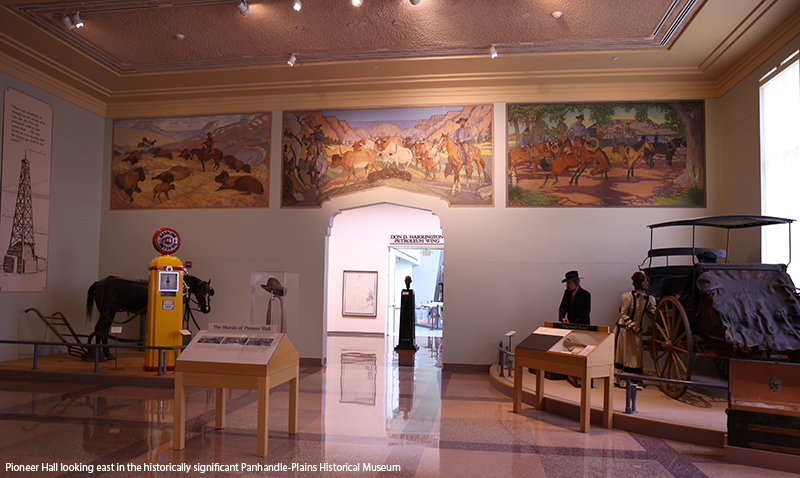
In 1933, the first portion of the museum, approximately 12,000 square feet of Pioneer Hall, was built. Once completed, it stood as the first university museum in the State of Texas and the first in the tri-state region. Over the years, investments were made in the PPHM and the collection to promulgate the importance of the Panhandle to the state and the nation. Frederick J. Turner, in “The Significance of The Frontier in American History 1893,” most appropriately cataloged the importance of the Panhandle to the future of Texas. He wrote,
“That coarseness and strength combined with acuteness and inquisitiveness; that practical, inventive turn of mind, quick to find expedients; that masterful grasp of material things, lacking in the artistic but powerful to effect great ends; that restless, nervous energy; that dominant individualism, working for good and for evil, and withal that buoyancy and exuberance which comes with freedom—these are traits of the frontier, or traits called out elsewhere because of the existence of the frontier.”
Turner’s comments exhibit what I call “spit,” and I see it evidenced today in faculty, staff, students and their families. The notion of entrepreneurialism and freedom of thought cataloged through the museum’s holdings tells an invaluable story in the names, faces, times and places of our region and state. Those qualities remain central to who we are and whom we aspire to be.
Hattie Anderson’s vision and prophetic wisp regarding the remarkable Panhandle region’s power is essential to our future, a recognition felt through the architectural grandeur of Pioneer Hall and the collection housed within. An expansion was necessary just a decade after the museum opened. On three other occasions, the physical facilities of the museum grew yet again. PPHM was declared a Texas Centennial Museum in 1936. PPHM was also part of the Works Progress Administration, leading to murals by Ben Carlton Mead and H.D. Bugbee.
So many items and artifacts—totaling some 2.4 million glimpses into our region’s heart through stone, paper, paint, bone and technology—move and guide us forward. They collectively tell a story of resilience, innovation and identity that belongs to all who call the Panhandle home. A positive trajectory.
But PPHM is not merely a storage place for items on a shelf; the museum’s importance is felt not only in the artifacts but also in its service to Canyon, Amarillo, the Panhandle community at large and indeed our state and nation. This is evidenced in the fact that every ISD in the Texas Panhandle is served by PPHM, both in school groups coming to the museum or museum educational staff going to all corners of the region.
WT is the birthplace of the PPHS and has always been home to PPHM. As property of the State of Texas, WT belongs not to a few, or a distinctive region, but to the whole state and all her citizens. On the West Texas A&M University campus, in the Panhandle-Plains Historical Museum, are the artifacts retelling a story from history and plotting a path into the future that no one should miss. As the staff at the museum says, “We are concerned not only with history makers but also the future history makers of this region.” That charge underscores why the museum remains essential to our shared future and why a state university campus is the ideal place for such a treasure.
Walter V. Wendler is the President of West Texas A&M University. His weekly columns, with hyperlinks, are available at https://walterwendler.com/.