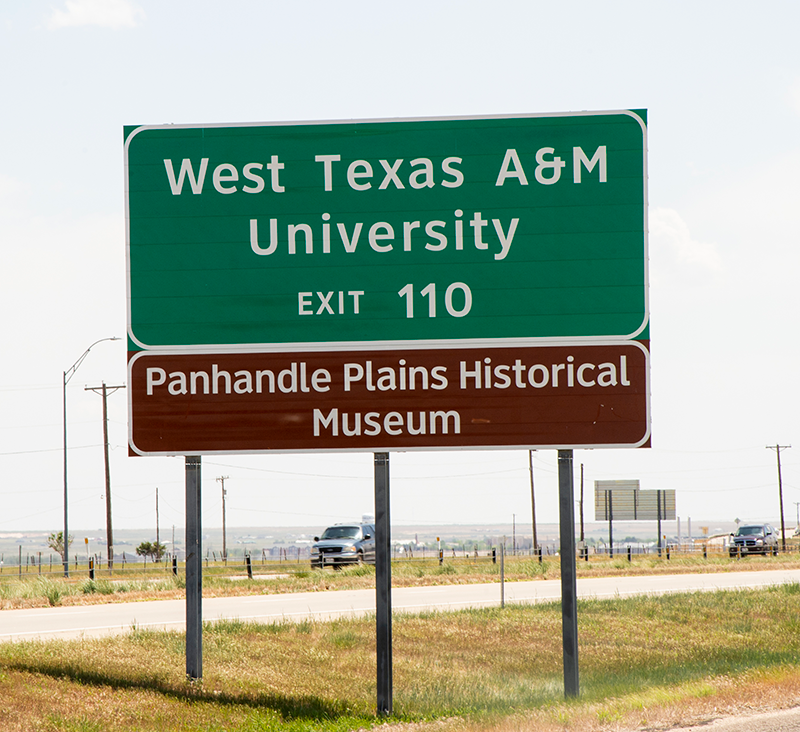
Fourth in a series on the Panhandle-Plains Historical Museum.
The closure of the Panhandle-Plains Historical Museum (PPHM) has sparked grief, anger and finger-pointing among some. Many want to know how one of the largest history museums in the nation, and the largest in Texas, that has preserved the story of the High Plains for nearly a century, could be allowed to fall into disrepair to the point of being unsafe? I will provide an answer.
The uncomfortable truth is that the issues with the PPHM are not due to a lack of community support or cultural values. The disrepair that has made the PPHM unsafe is the result of a decades-old funding model that was not designed to sustain the facilities in the long term and has not provided funds for upkeep. At the heart of the problem is a little-known and often misunderstood feature of Texas public higher education funding: Education and General Use (E&G) facilities designation and funding on university campuses.
In Texas, E&G buildings are those whose primary purpose is the educational mission of the university, like classrooms, faculty and staff offices, libraries and core academic research facilities. E&G facilities qualify for state funding. For example, Capital Construction Assistance Projects (CCAP) funds, formerly known as Tuition Revenue Bonds (TRBs), are restricted to E&G facilities on university campuses. CCAP funds must be requested through the legislative process, which, for WT, means working within The Texas A&M University System (TAMUS), which includes 12 institutions. And, all Texas public universities compete for CCAP funds.
Allow me to provide examples of CCAP funding for E&G facilities at WT. In 1928, the third building on the WT campus, the 59,744 sq. ft. Education Building, was completed at a cost of $300,000 ($5.03 a sq. ft.). WT recently opened the renovated 64,312 sq. ft. Geneva Schaeffer Education Building at a cost of $38.5 million ($598.65 a sq. ft.), representing a 12,833.33% increase in construction costs from the 1928 original cost. Using the same increase in costs, the original 11,177 sq. ft. PPHM Pioneer Hall, which was built for $50,000 ($4.48 a sq. ft.) in 1933, today would cost more than $6.4 million ($572.60 a sq. ft.). Some will find the costs unbelievable, but those are the costs to build.
The construction which has occurred on the WT campus along Russell Long Boulevard is an interesting look at combined state, private and auxiliary funding (facilities which generate revenue to cover costs). Jarrett Hall, which was fully renovated in 2018, is an auxiliary facility funded with housing costs paid by residents. The Happy State Bank Academic Research Building, Piehl-Schaeffer Pavilion and Bain Arena were funded with CCAP funds and private donations (75%, 25% split). The Texas A&M Veterinary Education, Research and Outreach facility was funded with the Permanent University Fund (PUF) from The Texas A&M University System. The Texas Veterinary Medical Diagnostic Lab was funded from direct appropriations from the state. And the soon-to-open Texas A&M AgriLife Extension and Research Building was funded through TAMUS PUF and AgriLife Research and Extension funding.
E&G buildings receive state funding. Museums are not designated as E&G facilities. Not a single museum on a university campus in Texas is supported by direct state appropriations. The Bullock Museum in Austin, not associated a university, is the only museum in Texas supported by direct state appropriations.
The PPHM is not an E&G facility. The primary purpose of PPHM is to be a museum, as important as that is to the extended community and to our faculty and students, it is not a university educational facility. Auxiliary facilities such as athletics complexes, food service dining halls and residence halls generate funding to cover both construction and operational costs. The PPHM is the only building on any A&M System campus that is not an E&G facility or an auxiliary facility covering operating expenses.
When PPHM was founded at West Texas Normal College, every student was preparing to be a teacher of some sort. Since then, WT’s educational mission has changed, so too has the public’s interest and investment in museums. When the PPHM opened, Pioneer Hall was built, and there was a partnership between the state and local governments to fund the museum operations. The funding strategies of the state have changed, as have those of local governments. In 1984, WT received $762,568 annually from the state for maintenance and operation of the museum (in today’s dollars, that equals over $2.378 million). Today, WT receives $266,537 from the state for the PPHM. The PPHM operation costs, which are currently taken from WT’s general budget, are almost $100,000 per month ($1.192 million annually) at a cost of nearly $129 per student.
Over the years, universities with museum facilities—West Texas A&M University, Texas Tech University and Sam Houston State University—have repeatedly tried to find a means for E&G funds by having classes taught in museum spaces, pointing out how faculty conduct research, making exhibits connect to degree programs and even conducting experiential learning for students in the museum. Visiting a museum for class credit does not make the museum a classroom, nor does research conducted in public exhibit space turn a museum into a research laboratory, nor does a museum’s cultural and civic value transform the primary purpose of a museum.
University facilities slowly accumulate deferred maintenance, building codes change and safety upgrades are delayed. Universities like WT are forced to decide which facilities receive much-needed repairs and upgrades with limited funds, most of which are designated for specific types of campus facilities. The PPHM facilities repair and upgrade “can” has continually been kicked down the road. As president, I cannot allow it to be kicked any further.
The PPHM situation is not one of negligence; it is the result of funding models and priorities changing. PPHM was founded in the early twentieth century during an era of civic optimism when universities were seen as natural stewards of regional culture. That model worked for a time, especially when buildings were new, and regulatory demands were modest.
WT has worked relentlessly to cast a bold vision for the future, as stated in the long-range plan WT125: From the Panhandle to the World. Our vision is bold even in the face of narrowing higher-education finance and enrollment hurdles. Ironically, the arguments that demonstrate PPHM’s public mission and statewide importance in preserving Texas history in service to the region are the very arguments that disqualify it from funding available to WT.
The lesson of the Panhandle-Plains Historical Museum is larger than any single issue or problem. If Texans want to preserve their history in the PPHM, the museum’s funding must align with funding sources and governance structures that exist today, a task to which I remain committed to pursuing. Until then, no amount of passion or nostalgia will be enough to keep its doors open.
None of this diminishes our commitment to finding a way to keep the museum operating in Canyon on the WT campus, serving our university, our region, and our state.
Walter V. Wendler is the President of West Texas A&M University. His weekly columns, with hyperlinks, are available at https://walterwendler.com/.