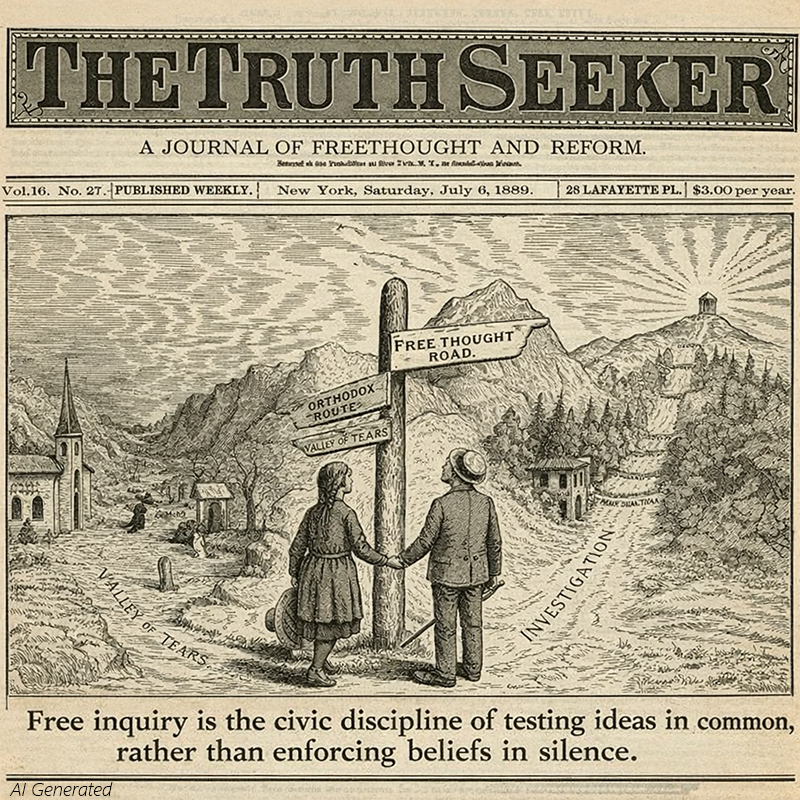
American higher education is facing a crisis more serious than declining enrollment or rising costs. It is a crisis of confidence. Public trust earned over generations is eroding in a season of shortsightedness. Families question the value of degrees. Legislators question the purpose of universities. Students question whether institutions exist for disciplined inquiry or as platforms for persuasion. William Inboden presents a balanced view of the challenges in a National Affairs article titled, “Restoring the Academic Social Contract.”
At the core of this crisis lies a dangerous confusion: mistaking ideology for ideas. Universities exist to pursue knowledge, not to endorse beliefs. Ideas are fundamental to academia, meant to be challenged, tested with evidence, and refined through debate. Ideas do not shy away from scrutiny; they thrive on it. A healthy university acknowledges human fallibility and depends on disciplined debate to discover truth. The rise of ideology from intellectual weakness conflicts with this goal.
When ideology calcifies into orthodoxy, it resists examination, substitutes certainty for curiosity, replaces persuasion with pressure, and demands alignment rather than argument. Political ideology, from the left or the right, crushes free inquiry when it becomes the lens through which all questions must be filtered.
Universities thrive when free inquiry turns into ideas. Systematic suspicion and scrutiny are not distractions from learning; they are the foundation on which it rests. However, too often activism replaces inquiry. Institutions favor disruption over discipline. The “civic university” shifts to the “dogmatic university,” aligned with global capital, political agendas, or utopian causes. In the process, humility diminishes. The pursuit of truth gives way to the pursuit of influence. The public observes faith waning and cynicism increasing as the intellectually undernourished, protected by campus facades and thought police, criticize the uninformed suspicions of the average American.
Taxpayers support public universities with the expectation that they serve the common good, not partisan interests. Parents send sons and daughters to campus expecting intellectual challenge, not ideological choreography. When universities appear more committed to enforcing fashionable consensus than encouraging courageous debate, higher education squanders moral authority. It takes decades to earn trust, but it can be lost in a heartbeat.
The remedy is not neutrality about truth. Universities must seek truth, integrity and excellence. But they must pursue these through evidence and argument, not enforcement. Academic freedom is not a decorative privilege; it is earned, never given. It demands rigor, accountability and courage. Liberty for free thought fused with free will is the foundation of a free society. Nothing else works.
Institutions that suppress ideas in pursuit of moral certainty inevitably betray the very ideals they claim to defend. Every age has its sacred certainties. Universities must be a place where even those certainties can be examined without fear. When disagreement is treated as deviance, inquiry contracts. When ideas flourish, freedom expands.
The modern inversion is subtle but real: institutions hold ideology high while merely tolerating ideas. Diversity of thought is proclaimed but selectively practiced. Academic freedom is praised but cautiously managed. Certain arguments are rewarded but others are quietly discouraged. Students learn the grammar of compliance rather than the habits of disciplined thinking. That path leads not to excellence but to irrelevance.
A republic depends on institutions that free minds and hearts. From Morrill’s founding of the land-grant movement to the GI Bill (both ideas), American universities have been stewards of the constitutional experiment. They educate citizens, not merely credentialed workers or thinkers who mouth the ideology of the day. They understand that freedom requires intellectual resilience and toughness to sustain people capable of hearing opposing arguments without retreating into resentment or rage.
To restore public trust, universities must recover their civic mission. First, recommit to free inquiry, fiercely and visibly, encourage structured debate and teach students how to argue with evidence and civility. Second, hire and reward merit, performance and integrity. When universities are led and staffed by individuals of high talent and high character, they prosper. When conformity replaces competence, decline follows. Third, focus relentlessly on mission. Never change mission as a response to crisis. In tough times, devotion to mission is elevated, not diminished. And fourth, cultivate humility, civility in a word. No generation has a monopoly on wisdom. The university must model what it teaches: intellectual modesty coupled with moral courage. The call to restore public trust is not a call to abandon values, but a call to pursue them rightly. A university should never be an echo chamber for the left, right or otherwise. A university should be a forge where ideas are tested in the heat of disciplined disagreement. When ideology dominates, inquiry diminishes. When ideas flourish, trust grows.
The choice before higher education is clear. Institutions become advocacy organizations with tuition bills or they return to their roots as communities of inquiry bound together by a shared commitment to truth. A university can chase applause or earn respect, manage perception or steward principle.
Historian Morris Berman accurately observed in Coming to Our Senses that “An idea is something you have, an ideology is something that has you.” If universities want to stay credible as centers of learning rather than slip into obscurity, they must reaffirm a fundamental truth: loyalty to ideas over ideology. Academic excellence thrives in the clear light of disciplined ideas, a light that must not be overshadowed by the false intellectual shadows of ideology.
Walter V. Wendler is the President of West Texas A&M University. His weekly columns, with hyperlinks, are available at https://walterwendler.com/.