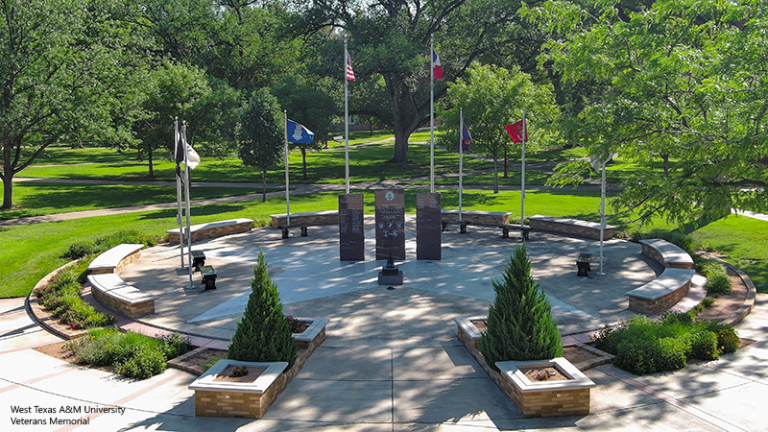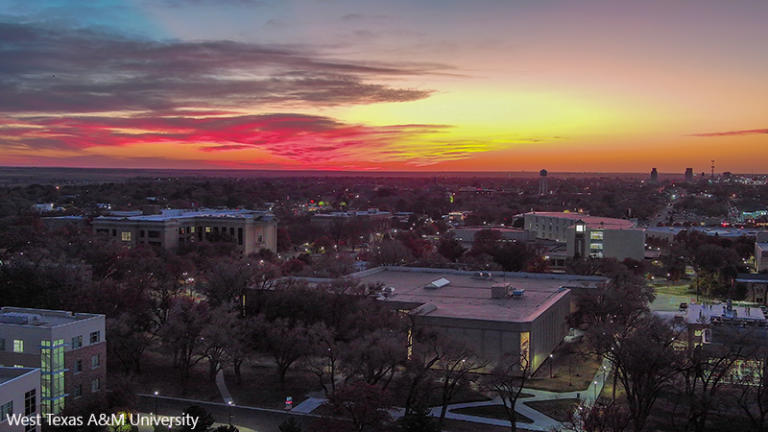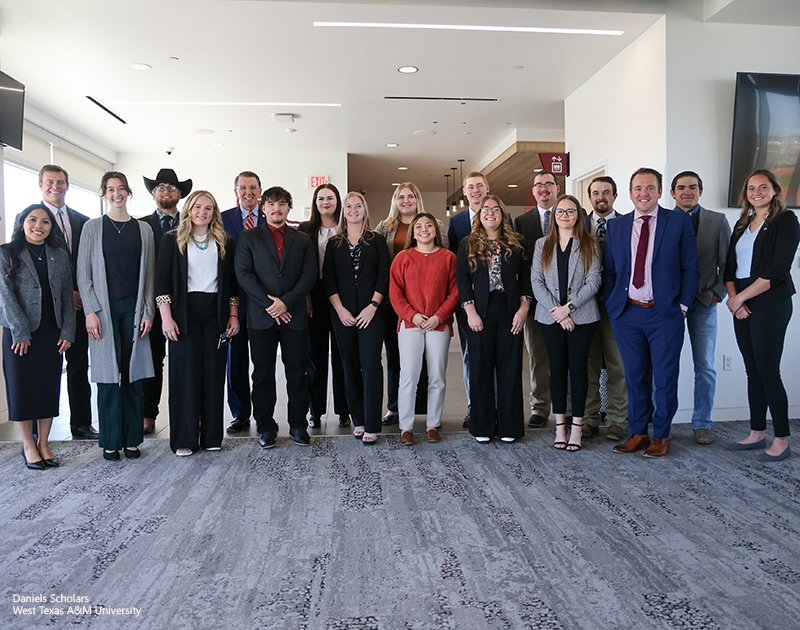
Recently, I had lunch with Daniels Scholars at West Texas A&M University. These bright, focused, and principled students are part of an exceptional program based in Denver, Colorado. These scholars could attend almost any university in the country and have up to $100,000 in tuition, room, and board covered. More than twenty Daniels Scholars have chosen WT.
For the three scholars sitting at the table with me, I asked a simple question: “With one word, why are you at WT, given your many options? Just one word, please.” Their answers were people, price, and place; a fourth word, product, was added by Doug Lipinski, VP for Athletics, who was the fifth person at the table. People, price, place, and product, guided by a thoughtful process, should serve as a philosophy of higher education and the foundation of a mission-driven university.
People are the heart of any university because education is relational, a fact the Daniels Scholars understand. Universities do not exist for buildings, rankings or bureaucracies. They exist for students and faculty. The main reason for all university actions should be students: their aspirations and needs. The process must serve people, not the other way around. Faculty determine academic quality. No accreditor, legislator or leader of any kind, at any level, replaces dedicated teachers committed to student growth. Excellence occurs when faculty and students walk the same path together, committed to ideas, standards and character. Relationships build culture, not rules. Students are aspirants seeking transformation, not customers buying a credential. When faculty invest in students’ intellectual and moral growth, the university becomes more than just an institution; it becomes a community of aspirations. A student with a strong sense of self attending a university that values self-awareness is a powerful combination. Education is a two-way street. Students shape the institution just as much as the institution shapes them.
Price affects affordability and is a moral duty for a public institution, not a marketing ploy. It is a matter of public trust. Public universities rely on taxpayers and are trusted by families. Rising costs weaken confidence and raise questions about the value of degrees. When institutions increase tuition without thinking, families bear the burden, often in debt that lasts for decades. At WT, we advise students to compare costs directly. Bring us another offer, and we will try to match or beat it. That is true stewardship, not desperation. Price means being disciplined, not cheap. Clear priorities, honest trade-offs, fiscal restraint and transparency define price. Trust builds when institutions show they value family sacrifices. Affordability and trust are closely linked.
Place shapes mission. For a regional university, place is fundamental, not incidental. The Texas Panhandle is vast, dry, industrious and proud. Agriculture, energy, cattle feeding and wind are livelihoods, not abstractions, shaping expectations and character. WT exists first for the people of this region. Over 70 percent of the teachers and administrators in the top 26 counties hold at least one WT degree or certificate. A fact that reveals mission fidelity, not a coincidence. All education is local. Universities untethered from their community’s drift toward abstraction. When institutions detach from the people who sustain them, clarity erodes. We are not Houston, Austin or Dallas. We are the Panhandle. We are proud. Place creates culture. Campuses are crucibles of human interaction. Laboratories, rehearsal halls, classrooms and libraries are environments where citizenship is formed. Relationships flourish somewhere, not nowhere.
Product promotes moral growth, and it is important. People, price, place, and product require energy fueled by an aspirational purpose. Without moral grounding, higher education becomes just transactional. With it, education transforms. At WT, The Hill Institute embodies our commitment to lasting principles: trust, hard work, personal responsibility, loyalty, regard for others, faith and virtue. These are cultural foundations, not partisan slogans. Universities cannot do their vital work without a moral perspective. Trust sustains a republic. Responsibility fuels liberty. Character anchors citizenship. The Daniels Fund itself exemplifies integrity, courage, leadership and service. Financial support without moral development is incomplete. Character without competence is not enough. Purpose unites both.
Added by Mr. Lipinski, the product is the transformative result of education. Handled improperly, the product alone diminishes education. If the product refers to a diploma, we have failed. But if it signifies an educated human being who can think critically, act ethically, work skillfully and serve faithfully, then we are on solid ground. The true product of a university is transformation reflected in the ability to reason, the discipline to work, the courage to lead and the humility to serve. Students may arrive seeking opportunity. They should leave prepared to become engaged citizens in a free society. Universities nurture human potential; we do not sell credentials.
Higher education faces a critical juncture. Some institutions drift toward abstraction: disconnected from people, indifferent to cost, unaware of their environment, uncertain of their purpose, and oblivious to their product. That course leads to decline. Students like the Daniels Scholars give me hope. They seek challenge, not entitlement. They want growth, meaning and belonging. They instinctively understand what institutions have forgotten: People matter most. Price is also important. Place influences identity. Purpose provides direction. The product is an educated citizen.
When relationships outweigh bureaucracy, when affordability reflects stewardship, when place anchors mission, when purpose shapes character and when product fulfills public purpose, excellence is achieved, and public trust flourishes. That is the work before us at West Texas A&M University. Daniels Scholars are a powerful representation of WT’s aspirations, a fact proven to me over a turkey sandwich.
Walter V. Wendler is the President of West Texas A&M University. His weekly columns, with hyperlinks, are available at https://walterwendler.com/.