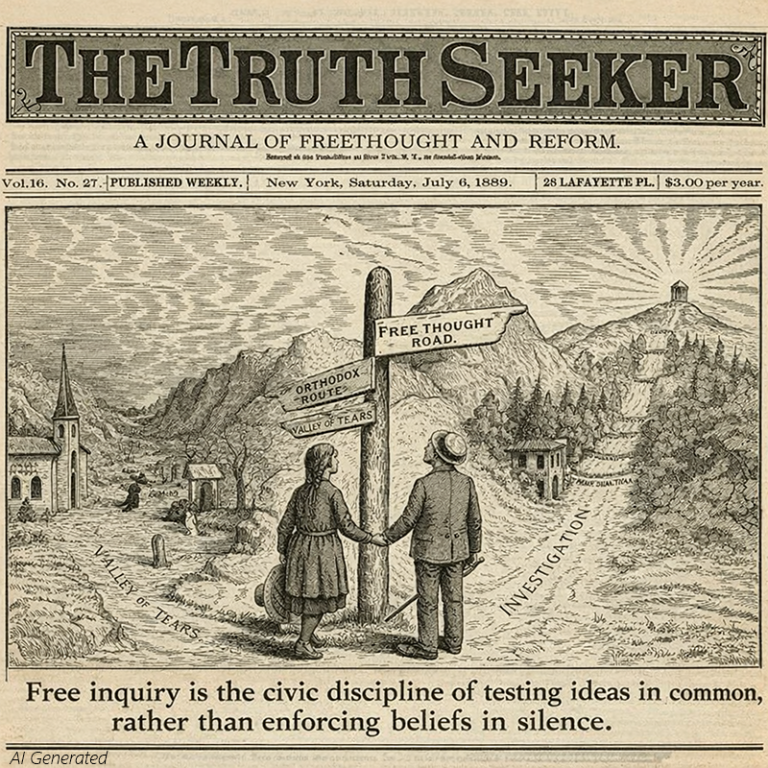
Sixth in a series.
In an era marked by polarization and rapid-fire opinion in sound bites, we would do well to remember a tradition that is the foundation of much of Western higher education: the practice of reasoned argument. This is not simply about debating for the sake of victory, but about seeking truth together honestly, humbly and with a shared commitment to understanding and learning.
The roots of this tradition stretch deep into the Judeo-Christian heritage. Contrary to the assumption that faith and intellectual inquiry are at odds, the biblical tradition demonstrates that questioning and respectful disagreement are central to human dignity and the search for truth. Across thousands of pages of the Talmud, rabbis dispute, interpret, refine and challenge one another’s views with analytical precision. Pirkei Avot, a rabbinic ethical text, praises “argument for the sake of heaven” as a sacred practice. Prophets like Abraham and Moses, and disciples like Peter, challenged and questioned, not out of rebellion, but out of a passion for the knowledge of truth forged in covenantal trust and concern for justice. In the Judeo-Christian tradition, disciplined and respectful arguments are not to be won, but to approach truth together through civility and mutual correction.
The Apostle Paul, for example, reasoned with others in markets and synagogues, not through coercion but through explanation and patient debate. Early Christian thinkers like Augustine in Confessions and Aquinas in Summa Theologica modeled faith and reason walking hand in hand, welcoming objections and responding thoughtfully, laying the groundwork for the modern university.
Medieval universities were lively communities where students and professors tested each other’s ideas in public, believing that rigorous debate honors both God and truth. Previously commenting on faith and reason, I said, “The very purpose and nature of a good university is lost in a theater without faith written into the play. We cannot be educated without an appreciation for the tense symmetry that exists between faith and reason.”
Today, the need for reasoned argument is as urgent as ever to counteract tribal loyalties and ideological conformity. “Too often, uncomfortable questions are silenced rather than explored,” as I have noted in Moral Perspective at Our University, “Public universities have tried moral abstinence for over half a century. It is not working.”
The Judeo-Christian tradition teaches that disagreement is not a crisis, but an opportunity for growth; that truth is approached through engagement, not avoidance; and that humility is essential because none of us possesses a monopoly on insight. John Locke noted in “An Essay Concerning Human Understanding” that our minds are a tabula rasa, “a clean slate,” meaning knowledge is generated through experience and perception. Christian thinkers, beginning with Paul in writing to the Romans, revealed that our slate is not completely “clean.” We have an innate knowledge of God as humans revealed through creation.
The purpose of the university is to allow experience and perception to be shaped and sharpened by reasoned argument. When universities value reasoned argument, they protect academic freedom. Faculty members must have the freedom to express themselves in their areas of scholarly expertise without fear of retribution, which is the purpose of tenure. Correctly exercised, this scholarly freedom promotes intellectual growth in students and among colleagues. Incorrectly pursued, it becomes grooming for ideological purity, an odious form of coercion. Reasoned argument is the height of purpose, while ideological purity is the bane of a free society. Our founders knew it and baked it into the nation’s birth certificate, the United States Constitution.
The antidote to bad ideas is not silence, but better arguments. “Toleration requires that each listen respectfully to all. Conviction demands that your personal perspective is valued by you and others through belief and faith. These perspectives can live side by side in a thinking human being in search of truth,” balancing toleration and conviction and allowing them to be knotted together. Another benefit of reasoned argument is that it fosters a culture of respect. The ideal of “arguing for the sake of heaven” ensures that debate is aimed at discovering truth, not simply scoring points. When we see argument as a shared search for understanding, we listen more carefully, speak more responsibly and treat one another with dignity, as I noted when reflecting on Faith and Reason in the Life of the Mind.
In the end, the dedication to reasoned argument that comes from the Judeo-Christian tradition has been and remains a critical support for the mission of the modern university. At a time when universities face polarization, the loss of civil discourse and threats to academic freedom, the ancient practice of reasoned argument as a moral discipline, intellectual method and communal pursuit of truth lights a path forward.
Let us, in universities and public life alike, reclaim the sacred practice of reasoned argument. It is not only the bedrock of scholarship, but the core of hope in a divided world.
Walter V. Wendler is the President of West Texas A&M University. His weekly columns are available at https://walterwendler.com/.