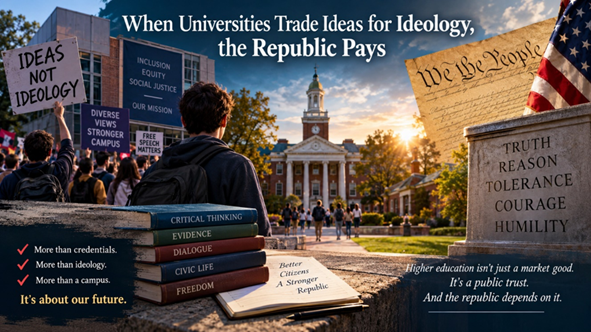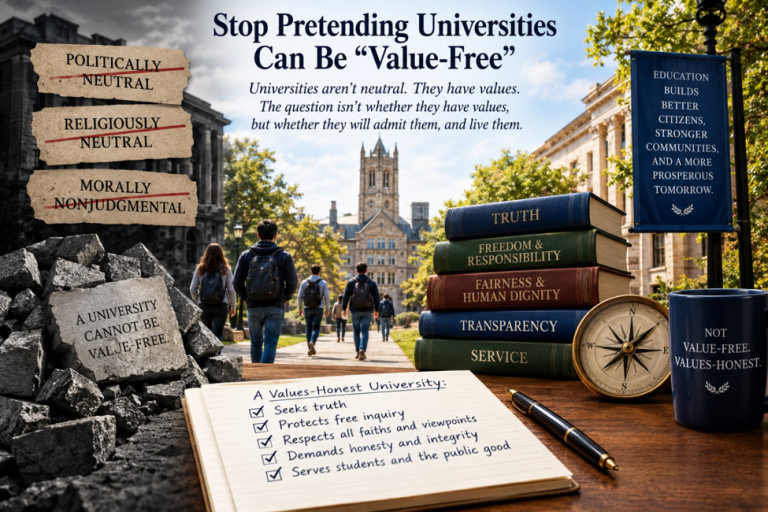

James Madison’s concerns about factionalism remain vital to the constitutional republic he helped bring to life. In Federalist 10, Madison warned that factions, groups organized around shared interests or passions, can polarize communities, distort judgment, and infringe upon the rights of others. His warning speaks directly to contemporary institutions, including American universities, where ideological uniformity, coercive conformity, and pressure to silence disagreement can overshadow the pursuit of truth.
Madison’s insights are especially relevant to higher education because he understood the relationship between knowledge and self-government. In an 1822 letter, he wrote, “Knowledge will forever govern ignorance; and a people who mean to be their own governors must arm themselves with the power which knowledge gives.” Universities have a unique responsibility to provide that power. They must protect open inquiry, resist internal and external coercion, and teach students how to engage disagreement without allowing it to become disrespect or hostility.
A shared vision offers a constructive alternative to factionalism. It does not require everyone to think alike. Rather, it calls for a clear, mission-rooted purpose that unites people even when they disagree. As Peter Senge suggested in The Fifth Discipline, visions are personal. But to impact an organization, vision must become community property. Suppressing differences for a season does not reduce conflict except superficially. Channeling energy toward service, excellent teaching, student success, meaningful research, affordability, and public trust can create positive purpose and constructive dialogue.
A shared vision also helps organizations resist capture by any single faction. Mission clarity and responsibility counter manipulation. They foster collaboration and encourage individuals to take responsibility for outcomes. When institutions clarify their mission and distribute responsibility, factions have less room to dominate and more incentive to cooperate.
Campus communities sometimes treat leadership with suspicion, as if any clear direction threatens shared governance. But shared governance should enliven vision, not veto it or devolve into power plays. Open collaboration between leadership and those carrying out the work strengthens both mission and culture. Leadership should not silence disagreement, but neither should disagreement become an excuse for paralysis.
Faculty play a unique role in shaping institutional vision, both inside the classroom and throughout campus life. Great teachers, like great leaders, articulate a motivating purpose and pursue it persistently. When enough faculty consistently foster open inquiry, intellectual seriousness, and shared purpose, these habits become part of institutional culture rather than isolated examples of individual excellence.
Universities must therefore prevent differences from overshadowing shared mission. Factions can polarize communities, infringe upon rights, and promote forms of identity-based or ideological politics that weaken a free society. When this happens, universities shift from the pursuit of truth and learning to battlegrounds for power. Without a shared purpose, competing groups cannot cultivate a common vision.
To counter factionalism effectively, institutions must commit to truth-seeking, student formation, measurable performance, and public trust. Shared vision grows when faculty, administrators, trustees, and staff say, “I will own my part of the work, and I will be accountable for outcomes,” rather than retreat into slogans or bureaucratic avoidance.
Intellectual freedom and moral courage are essential to this vision. Universities must resist both external pressures and internal drift toward sameness of thought. Institutions that welcome debate, tolerate friction, and require reasoned argument can hold together despite deep differences. Campus culture matters as much as policy. It should encourage honest debate, protect inquiry, foster dignity and respect, and measure quality by student outcomes and public value.
Universities reflect the full spectrum of human nature. They reveal ambition, ego, fear, self-interest, generosity, courage, and hope. Factionalism persists because groups form, power is pursued, and personal interests sometimes outweigh institutional mission. Madison understood this complexity. In Federalist 55, he wrote, “As there is a degree of depravity in mankind which requires a certain degree of circumspection and distrust, so there are other qualities in human nature which justify a certain portion of esteem and confidence.” Healthy governance, honest accountability, and shared vision seek this balance between circumspection and trust.
Madison reminds us that slogans alone cannot lower factional heat. Institutions need structures and habits that foster accountability. Personal responsibility for outcomes can mitigate factionalism in shared-governance environments. Too often, institutions replace responsibility with bureaucracy, distancing decisions from the people and purposes they are meant to serve.
Organizations must also recognize that broad agreement can coexist with deep but narrow disagreement. Treating disagreement as disloyalty is a mistake, whether in universities, faith-based enterprises, businesses, or other complex associations. President Dwight Eisenhower captured this principle in a 1954 speech at Columbia University: “May we never confuse honest dissent with disloyal subversion.” Sometimes disagreement is the sincerest form of loyalty.
Factions pose real dangers. They polarize communities, distort institutional priorities, and violate others’ rights. Yet universities can choose a better path. They can unite around teaching excellence, affordability, student success, honest inquiry, shared responsibility, and public service while preserving respectful debate on contentious issues. Disagreement can paralyze an institution if it is poorly led or allowed to become personal hostility. Disagreement without respect can become a fistfight that nobody wins. Healthy universities welcome disagreement when it is disciplined by reason, respect, and a commitment to human dignity.
Ultimately, combating factionalism depends not on uniformity or slogans but on shared mission, personal responsibility, institutional courage, and an honest culture. Universities must return to Madison’s wisdom: lasting freedom and progress depend not on suppressing differences, but on building structures and habits that channel human nature toward the common good. The choice facing higher education is clear: succumb to factional warfare or recover the enduring purposes of knowledge, truth, student flourishing, and public service.
Walter V. Wendler, Professor of the Practice–Higher Education Reform, Bush School of Government and Public Service; President Emeritus, West Texas A&M University; Chancellor Emeritus, Southern Illinois University Carbondale. Weekly columns available at walterwendler.com.