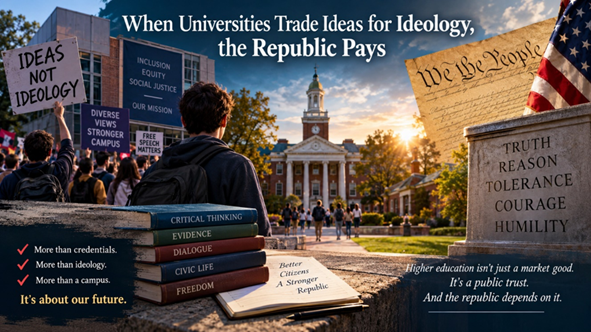

 In a rapidly shifting world, universities stand at the intersection of tradition and progress. Their purpose extends well beyond echoing cultural debates or providing credentials for employment. They are entrusted with a broader, enduring civic responsibility.
A university is a public trust; a civic institution charged with cultivating knowledge and forming citizens capable of sustaining self-government. This trust is reflected both in public respect and significant financial investment. For instance, according to a 2024 National Science Foundation report, taxpayers fund over half of all academic Research and Development spending, $4 billion at Johns Hopkins alone. Such investment signals public expectations that extend beyond job training or research output: society expects universities to serve the common good. This includes varied disciplines, but areas like medical research account for a substantial share of taxpayer spending.
Central to the university’s mission is the practice of disciplined thinking: testing claims with logic, evidence, and honest dialogue for the greater good. This form of inquiry is not competitive debate nor a fight for intellectual dominance; it is a collaborative search for greater understanding. Anything less puts academic freedom at risk, undermines trust, and leaves graduates underprepared at a real cost to the public.
The following nine precepts illustrate why students must engage in rational inquiry as the basis for engaging with differing perspectives, whether conservative or liberal; moral or scientific, without turning the university into a partisan or ideological institution. .
- Pursuit of truth over tribal loyalty. Tribalism turns disagreement into personal threat. Students arrive with beliefs shaped by family, faith and community. A university’s task is not to erase these commitments but to examine them. The goal is not cynicism, but intellectual honesty, a willingness to let examined truth shape and reshape convictions.
- Critical analysis as a habit of mind. Reason requires students to scrutinize all viewpoints through structured questioning. This skill applies equally to high-energy particle physics and 17th-century English literature. It reinforces thinking by exposing weak assumptions and contradictions. As C. West Churchman wrote in The Systems Approach, “There is no escaping the ethical dimension: every inquiry into a whole system is an ethical inquiry into the value of the system for all its participants.”
- Open-mindedness joined with humility. Scholar Edgar Schein emphasized that universities should foster humble inquiry in which students entertain different ideas without fear or by surrendering their values. Humility is crucial because no one holds a monopoly on insight. Constructive dialogue, not coercion, follows. Disagreement should be seen as an educational opportunity. Political philosopher Jürgen Habermas observed that, ideally, participants evaluate arguments based on reason and evidence, free from coercion. It is incumbent upon universities to cultivate an environment in which disagreement leads to deeper understanding, where students listen, clarify, and respond thoughtfully.
- Evidence-based judgment in an age of misinformation. Surrounded by opinion and misinformation, students must learn to anchor their conclusions in verifiable facts and credible sources, including by scrutinizing information from large language models (AI). This commitment is fundamental to scholarship and intellectual integrity.
- Respect for complexity may be an oversimplification. Many challenges, whether ethical, political, scientific, or cultural, are “wicked problems” not solved by simplistic binaries. Reasoned thinking prepares students to live with complexity, resisting reductionism and seeking integration.
- Independence from authority and trend. Universities should encourage independent thinking, avoiding both reflexive rebellion and conformity. Academic freedom thrives in cultures that resist external pressure and internal uniformity.
- Adaptability and growth through a willingness to reconsider. A reasoned mindset teaches students how and when to change their thinking in light of stronger arguments or new evidence. Maturity lies in self-correction, not stubbornness.
- Moral responsibility alongside intellectual skill. Intellect and morality complement one another; each is weakened without the other. Universities that ignore questions of meaning, duty, and consequence disconnect knowledge from ethical action.
- Civic readiness as a core obligation. A constitutional republic depends on citizens skilled at rational disagreement and prepared for ordered liberty. The university is more than a marketplace of ideas; it is a formative institution, charged with preparing students for self-government and civic responsibility.
Returning to the earlier example of taxpayer investment in research and development: truth and reasoned inquiry are essential in every academic discipline, not just science. When universities abandon these standards, whether for relativism or partisanship, they fail to meet public expectations.
Recent events underscore the importance of this commitment. At the 2023 Lawrence W. Swanstrom ’67 Memorial Lecture, Robert P. George’s talk on free speech was repeatedly disrupted by whistles and shouting, an unreasonable response in a university setting. Similarly, at Stanford Law School (March 2023), U.S. Court of Appeals Judge Kyle Duncan was prevented from finishing his speech due to protest. At Yale Law School (March 2022), students disrupted a bipartisan panel on civil liberties, preventing the panel from proceeding.
The true goal of higher education is not ideological conformity but the development of graduates: people capable of pursuing truth, engaging in civil argument, and living with moral seriousness among those with whom they disagree. This is how universities earn the public trust, prepare students for responsible engagement in a diverse society, and help repair our fractured civic fabric.
Walter V. Wendler, Professor of the Practice—Higher Education Reform, Bush School of Government and Public Service; President Emeritus, West Texas A&M University; Chancellor Emeritus, Southern Illinois University Carbondale. Weekly columns: walterwendler.com.