America’s colleges are losing the public, and the reasons aren’t mysterious. Gallup reports that only 31% of Americans now consider college “very important” — down from 70% a decade ago. A decade of decline is a verdict. People do not tolerate paying a premium for a product they suspect has been adulterated.
Universities ask families to borrow heavily. In return, too many campuses are seen as ideologically narrow, impatient with dissent, and disconnected from the communities that fund them. Expensive and detached is a double betrayal: the second defect destroys the very thing meant to justify the first.
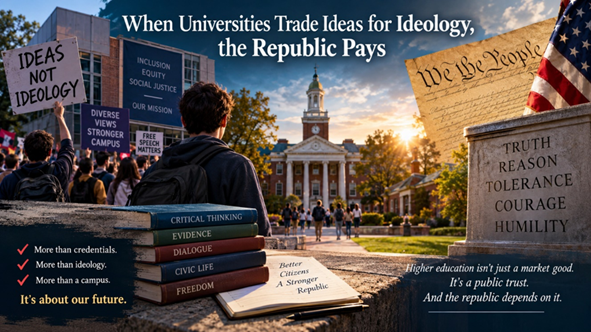
Ideological capture happens not through a single decision but through the slow accumulation of hiring, programming, and incentive structures that quietly shrink the range of permissible thought. When a campus functions like a political club with tuition, the public responds like any customer: it looks for the exit. But higher education is not simply a market good. It is a public trust. When it breaks faith with the public, the damage is civic, not merely financial.
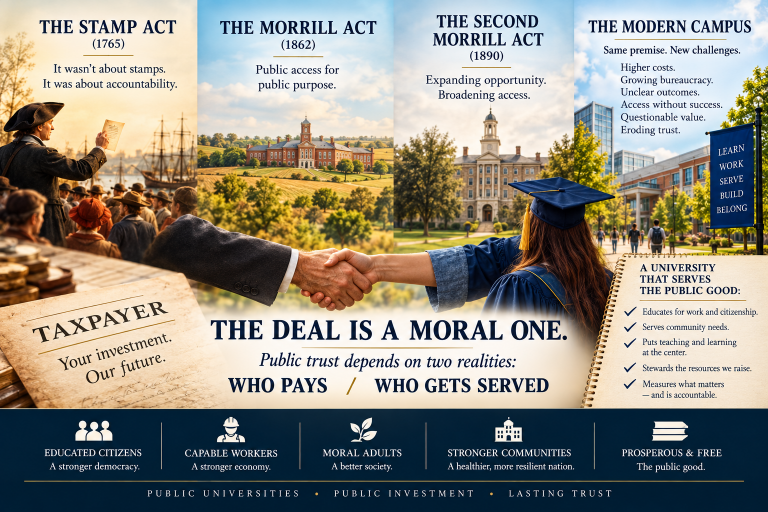
This is not a cultural squabble. It is a civic crisis. A constitutional republic cannot survive without citizens trained in the disciplines of freedom: restraint, reason, courage, and humility. The Morrill Act of 1862 sought “the liberal and practical education of the industrial classes in the several pursuits and professions in life.” Those tax dollars were meant to help people make a living and learn how to live as citizens. Universities too often aspire to do something smaller: Get the credential. Get the job. Don’t ask hard questions.
The evidence is not anecdotal. The Buckley Program found that over 60% of college students are intimidated about sharing their opinions on campus. Whatever else that number measures, it does not measure a culture of inquiry. Families in rural and traditional communities ask a concrete question: Will my student be taught to think, or taught what to think?
The decay is institutional as well as ideological. The American Enterprise Institute reports that 42% of college leaders cite added staff as the primary driver of rising costs. Bureaucracy compounds risk-aversion, and large organizations become addicted to the safest posture of all: sameness.
Education cannot thrive where ideas are feared. Institutional courage means defending the conditions that make open inquiry possible — resisting external political pressure and internal groupthink equally. A university that fights off the legislature while policing its own faculty has not defended academic freedom. It has only defended its monopoly on deciding what may be said.
Truth requires friction. Not cruelty — honest, civil, rigorous debate. Free speech is foundational to citizenship; academic freedom is foundational to the academy. Both decay quietly when no one defends them.
Scholarship bent to a predetermined conclusion has already stopped asking questions. When ideology displaces inquiry, students graduate more certain of their convictions and are less capable of examining them. Employers get credentials; communities lose citizens.
What does reform look like? Not a purge. Not a counter-ideology. Three concrete steps:
Make open argument a curricular requirement, not a slogan. Critical thinking is the catalyst of engaged citizenship. Require general-education courses to include structured disagreement — students arguing assigned positions they did not choose, graded on the quality of the argument, not the conclusion. Survey graduating seniors on whether they can articulate the strongest case against their own views and publish the results alongside placement rates.
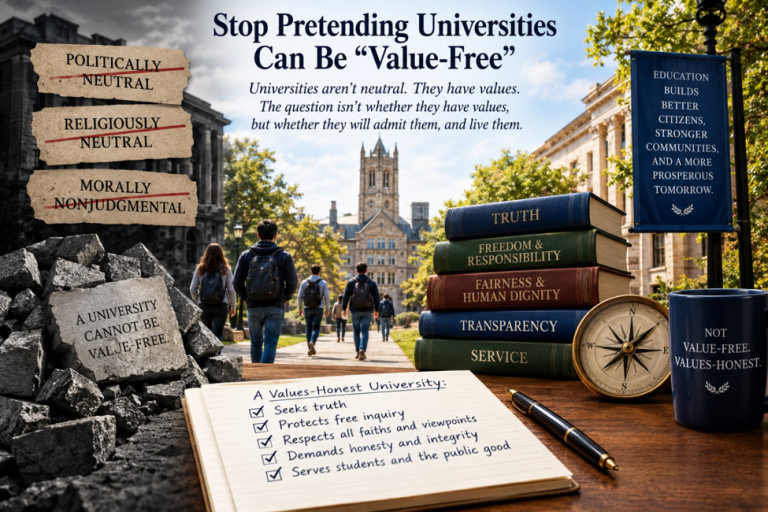
Restore the permanent questions without coercing the answers. What is justice? What is duty? What is human dignity? These belong in a required core, taught by faculty willing to debate, built on primary texts rather than summaries. Campuses that abandon the moral vocabulary of education do not become neutral — they become captive to whatever ideology is loudest that season.
Stop confusing comfort with learning. Publish grade distributions by department. Audit how much curriculum can be completed without sustained writing or a defended argument. High expectations and intellectual resilience are not cruelty. A university that coddles students is not kind; it is negligent. Families are paying for formation, not flattery.
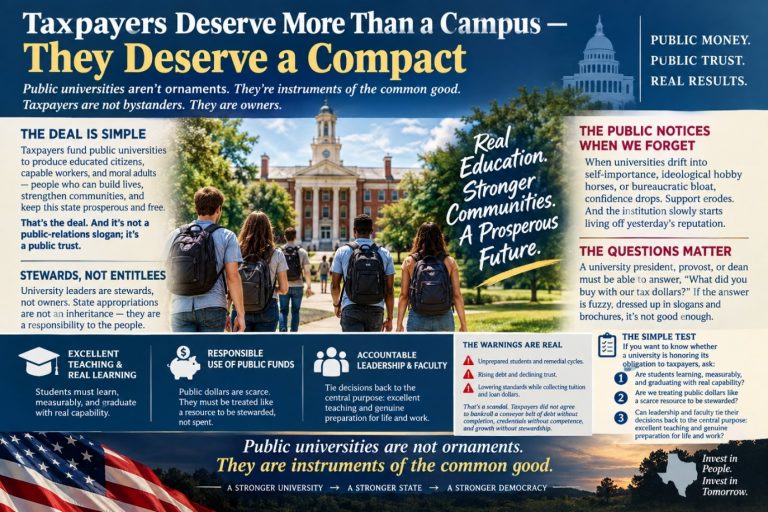
Universities will not rebuild trust through marketing. Trust is rebuilt through academic seriousness, intellectual openness, and moral integrity as perceived by students, parents, grandparents, elected officials, or university leaders. Trust takes generations to earn and a season to squander. A university is not a tool for social engineering. It is a steward of truth and a builder of citizens. That is not nostalgia. It is survival.
Walter V. Wendler, Professor of the Practice–Higher Education Reform, Bush School of Government and Public Service; President Emeritus, West Texas A&M University; Chancellor Emeritus, Southern Illinois University Carbondale. Weekly columns available at walterwendler.com.