Every few years, the same claim returns, often dressed up as sophistication: “A university should be value-free.” But after October 7, 2023, and in the campus protests that followed, many U.S. university leaders responded to antisemitism with generic statements condemning “all hate”—without specifically naming Jew-hatred. Jewish students and faculty reported feeling abandoned and less safe, as this ‘neutrality’ signaled indifference to their specific concerns.
This recent failure has exposed a wider problem. The opposite of a value-free university is not a politically captured one; it is a value-honest university: one that knows what it believes, explains why, applies its principles consistently, and accepts accountability when it fails. A university should be morally serious without becoming politically performative; it should be nonpartisan not because it has no values, but because its first loyalty is to truth rather than faction.
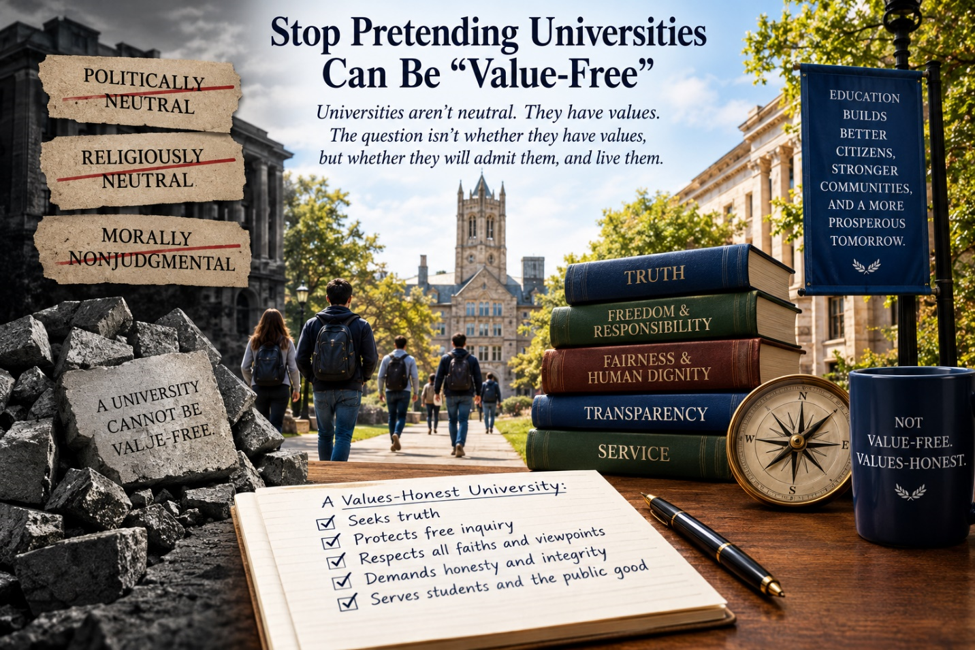
People heralding “neutrality” often mean one or more of three things: political neutrality, religious neutrality, and moral nonjudgment. Russell Kirk, in his Ten Conservative Principles, wrote: “The conservative believes that there exists an enduring moral order. That order is made for man, and man is made for it: human nature is a constant, and moral truths are permanent.” Kirk’s point isn’t institutional imposition of one morality; rather, humans can’t escape moral reality by declaring themselves neutral.
A university becomes ideological not because it has values, but because it treats contested conclusions as unquestionable truths.
A university can’t be administered as a value-free organization for the same reason a courtroom needs rules or a hospital needs triage: leadership means making choices, and choices are value-laden. Every budget, hiring plan, curriculum, and statement signals what an institution honors, tolerates, or protects.
The real issue isn’t whether universities have values, but whether they admit and live by them. The test is whether those values are explicit, defensible, consistently applied, and accountable. Anything else is bureaucratic theater. Moral and ethical commitments precede law; values are upstream, rules and laws downstream.
If leaders won’t openly defend the values making inquiry possible—civility, debate, evidence, fairness, intellectual freedom—the university does not become neutral but vulnerable. Into the vacuum step the loudest voices and best-organized groups. Too often, leadership prioritizes survival, bending to special interests and cronyism. That isn’t neutrality—it’s cowardice.
Public universities should not establish religion. But neither should they treat religious conviction as intellectually disqualifying or socially embarrassing. A university that excludes serious religious thought from public inquiry is not neutral; it is narrowing the range of reason itself. The assumption that students lack spiritual interests is inaccurate.
When universities treat religious conviction as embarrassment, they create silence and fragmentation, pushing important questions into corners. Contemporary students feel isolated, lack social cohesion, and trust to name a few pervasive issues, according to a 2023 U.S. Surgeon General’s Report. Religious engagement is often a positive rallying point that creates community and belonging.
An effective university must host deep differences—religious and otherwise—without collapsing into bigotry or groupthink. Ignoring the spiritual dimension does not elevate discourse; it shrinks it.
Universities cannot function without moral judgments. A reluctance to say, “this is wrong,” prevents affirming, “this is right, and it is excellent.” Public trust relies on truth-telling, especially given the real costs that accrue to families and students’ time and treasure.
Universities constantly face temptations: obscuring costs, inflating outcomes, overpromising careers, recruiting for revenue rather than service. Their job is to serve students honestly, even if truth reduces enrollment. Fail that, and they’re not educators but salespeople.
Pretending morality can be replaced by procedure leads to evasion. Responsibility dissolves into paperwork, real perspective sacrificed for rules sheltering insiders and diffusing accountability. Institutions rot this way: slowly, politely, by committee agenda, from the inside out.
The values a healthy university must defend are not controversial:
– Truth is objective and worth pursuing.
– Freedom and responsibility are inseparable in scholarship, speech, teaching, and governance.
– Fairness and human dignity must never be compromised.
– Transparency is a moral duty.
– The mission is service to students and the public good—not institutional self-preservation.
Universities earn trust through countless visible acts, not spin. They lose it quickly, sometimes with one mistake. The university exists to pursue truth, cultivate judgment, transmit civilization, discipline the mind, and prepare students for responsible freedom.
If a university cannot state what it stands for—or refuses to say so— why should anyone trust it to teach the next generation? Higher education needs leaders willing to say, calmly and clearly: we stand for something, and we will be held accountable to it.
Walter V. Wendler, Professor of the Practice, Bush School of Government and Public Service, President Emeritus, West Texas A&M University and Chancellor Emeritus, Southern Illinois University Carbondale. See https://walterwendler.com/.