Americans argue fiercely about the value of higher education. Tuition climbs, student debt swells, and public confidence wobbles. Some respond with public relations campaigns. Others respond with raw politics. To recover our bearings, it helps to revisit a document that emerged from the same remarkable political moment as the Constitution: The Northwest Ordinance of 1787.
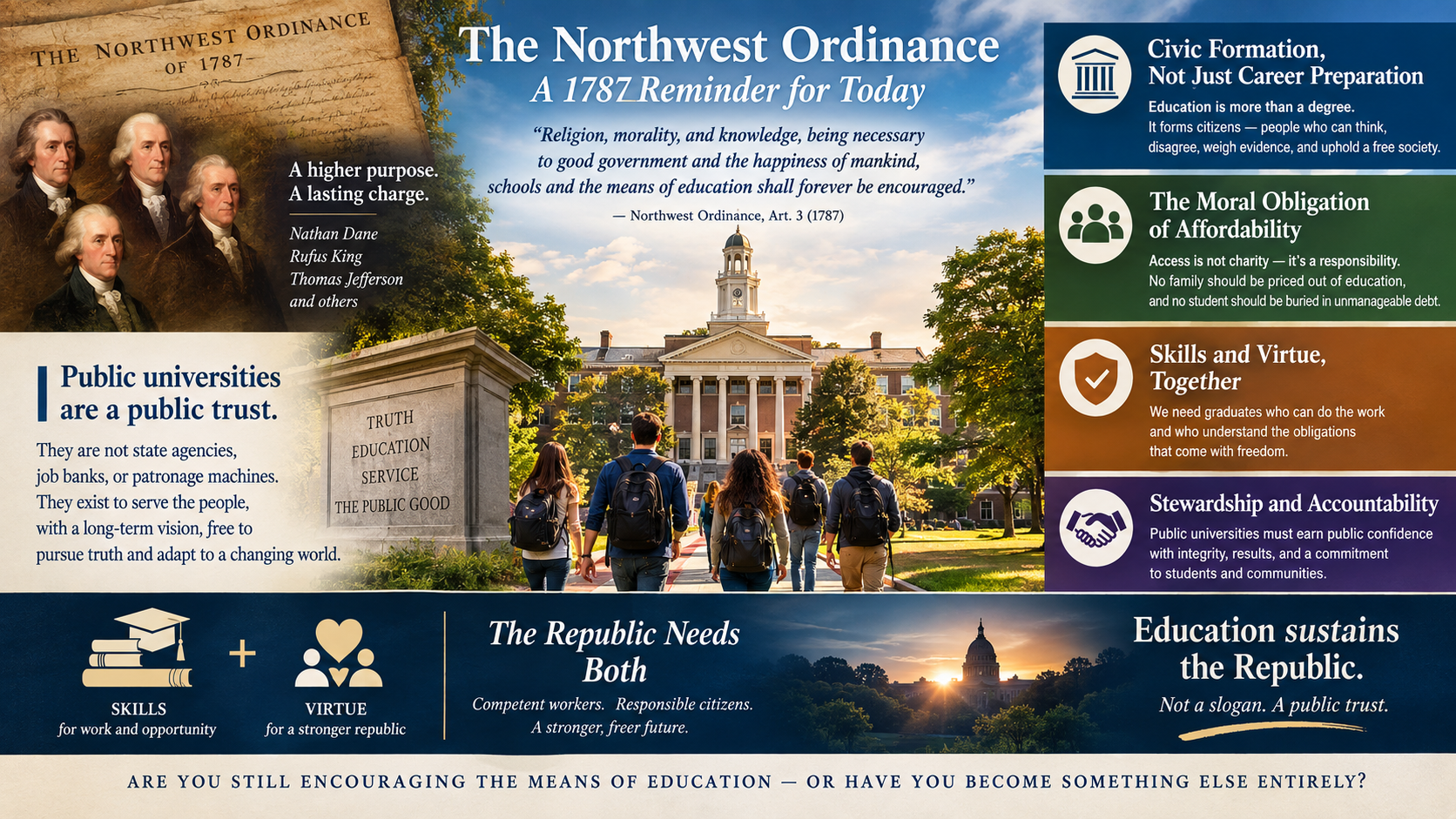
In a single line, it ties the health of the Republic to education: “Art. 3. Religion, morality, and knowledge, being necessary to good government and the happiness of mankind, schools and the means of education shall forever be encouraged.”
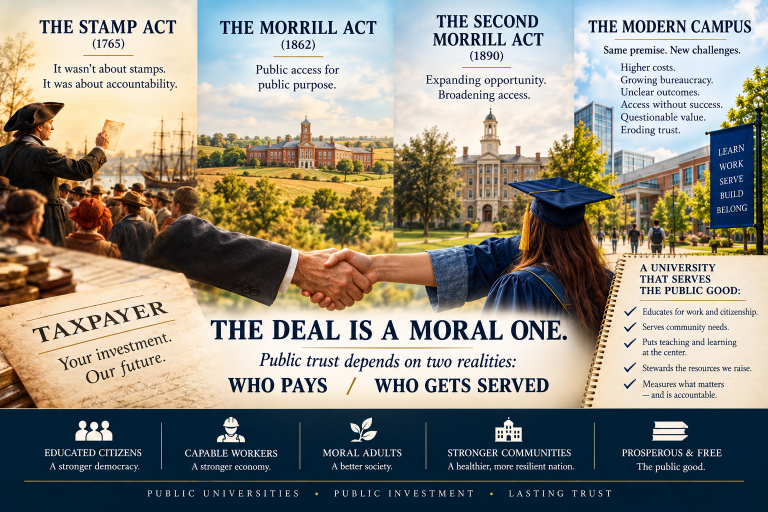
That is not a sentimental slogan. It was the seed corn for the Morrill Act of 1862, which created land-grant universities. It is a statement of purpose: a stark reminder of what education owes to a constitutional republic and what public universities owe to the people who sustain them, taxpayers. The Northwest Ordinance reminds us of three truths we have allowed to drift out of focus: public universities are a public trust; education is civic formation, not just private advancement; and affordability is a moral obligation, not an optional feature.
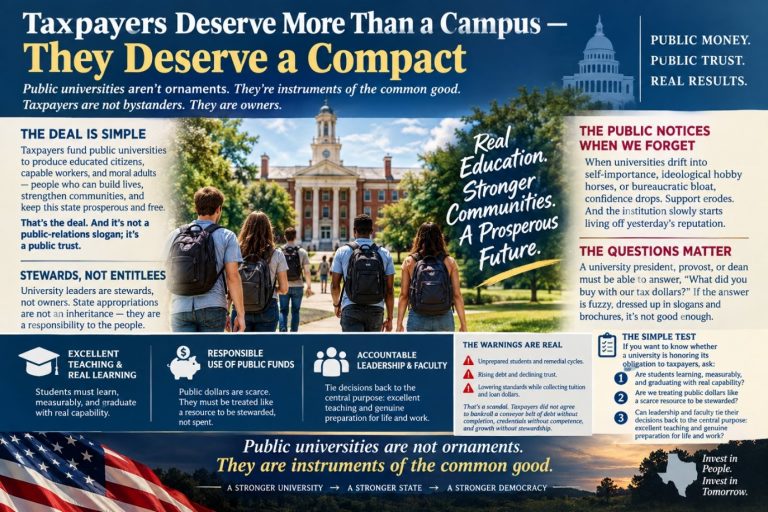
First, a public university is a public trust with institutional obligations and strict accountability. When universities forget what they are, they begin to operate as something they are not: state agencies, corporate job banks, or political patronage machines. The core mission dies by suffocation, and the institutions become bureaucratic shells.
The Northwest Ordinance still instructs us. It does not describe education as a consumer product. It describes it as a pillar of good government. That means prestige games, marketing campaigns, or ideological theater cannot justify public higher education. Confidence is earned the old-fashioned way: by serving the public with integrity and visible results. In practice, that means ideological heterogeneity rather than DEI preferences; equal treatment of all students; open inquiry that resists informal taboos and speech codes; an understanding of citizenship grounded in duty and responsibility rather than grievance; and a serious, honest engagement with Western traditions. Reasonable people disagree about each of these, and that is precisely the point: a public university’s job is to host that disagreement, not to settle it in advance. The most serious threat to confidence is not any single policy but the perception that outcomes are fixed before the argument begins.
Second, education is not just workforce training; it is citizenship training, undertaken with moral seriousness. Twenty-first-century pragmatism routinely reduces college to a simple transaction: pay tuition, receive a credential, get a job. That logic is understandable, but it is incomplete. Jobs matter. Skills matter. But if we aim only at economic utility, we produce something thinner than education—a kind of sterile expertise.
A constitutional republic does not run on technical competence alone. It runs on citizens capable of sound judgment. For universities, truth-seeking and character formation are not add-ons; they are foundational. Objective truth, discoverable through rigorous study, remains the bedrock of the university’s mission. Without that conviction, universities drift toward propaganda, corporate fads, and shifting cultural opinions, losing the credibility required to lead.
The Northwest Ordinance’s linking of religion, morality, and knowledge does not require a sectarian campus. It requires an honest campus. It insists that freedom and self-government depend on moral formation. Said bluntly: a constitutional republic without moral formation degrades into manipulation. The idea that education can be morally neutral in its consequences for self-government is faulty.
Universities have an obligation to cultivate both skill and virtue. A public university should graduate nurses and engineers who can do technical work while functioning as citizens who understand the obligations that come with freedoms. If universities want the public to trust them again, they should stop acting embarrassed about teaching civic responsibility and moral reasoning. They should teach students how to think, disagree, weigh evidence, and live as responsible adults in a free society.
Finally, affordability is a moral duty, not a flexible budget line. There is no honest way to celebrate education as “necessary to good government” while making it financially out of reach. If education is part of our civic infrastructure, access is not charity. It is a responsibility.
With national student debt passing $1.8 trillion, according to the Federal Reserve, we are drifting toward a system where students mortgage their futures for promises that may or may not be kept. When universities enroll students whom they have reason to believe are unlikely to succeed, particularly when those students finance the gamble with borrowed money, the institution may call it opportunity. But when the risk is foreseeable, and the debt is permanent, the promise of opportunity looks uncomfortably close to exploitation.
Public universities must be able to say to families with confidence: We will steward your resources. We will not waste. We will teach well. We will help students finish. We will not sell false hope on borrowed dollars. Some would say saving public higher education is impossible. I don’t believe that, but it requires a model of academic leadership on campuses that have a steel spine.
The Northwest Ordinance does not solve every modern collegiate problem. But it gets the premise right: education sustains the Republic. Public universities must recover the courage to be what they claim to be: truth-seeking institutions that form capable, responsible citizens and offer real value at a price families can bear. The way forward is not more slogans. It is mission clarity, moral seriousness, and stewardship—the very things Americans have always expected from institutions supported by the public purse.
Walter V. Wendler, Professor of the Practice, Bush School of Government and Public Service, President Emeritus, West Texas A&M University, and Chancellor Emeritus of Southern Illinois University Carbondale. His weekly columns, with hyperlinks, are available at https://walterwendler.com/.