America has argued about the legitimacy of public institutions for a long time. We like to pretend today’s quarrel over higher education is new, born of cable news, culture war skirmishes, or sticker shock on a tuition bill. It isn’t new. It’s as old as the Republic’s insistence that public authority must answer to public aspiration.
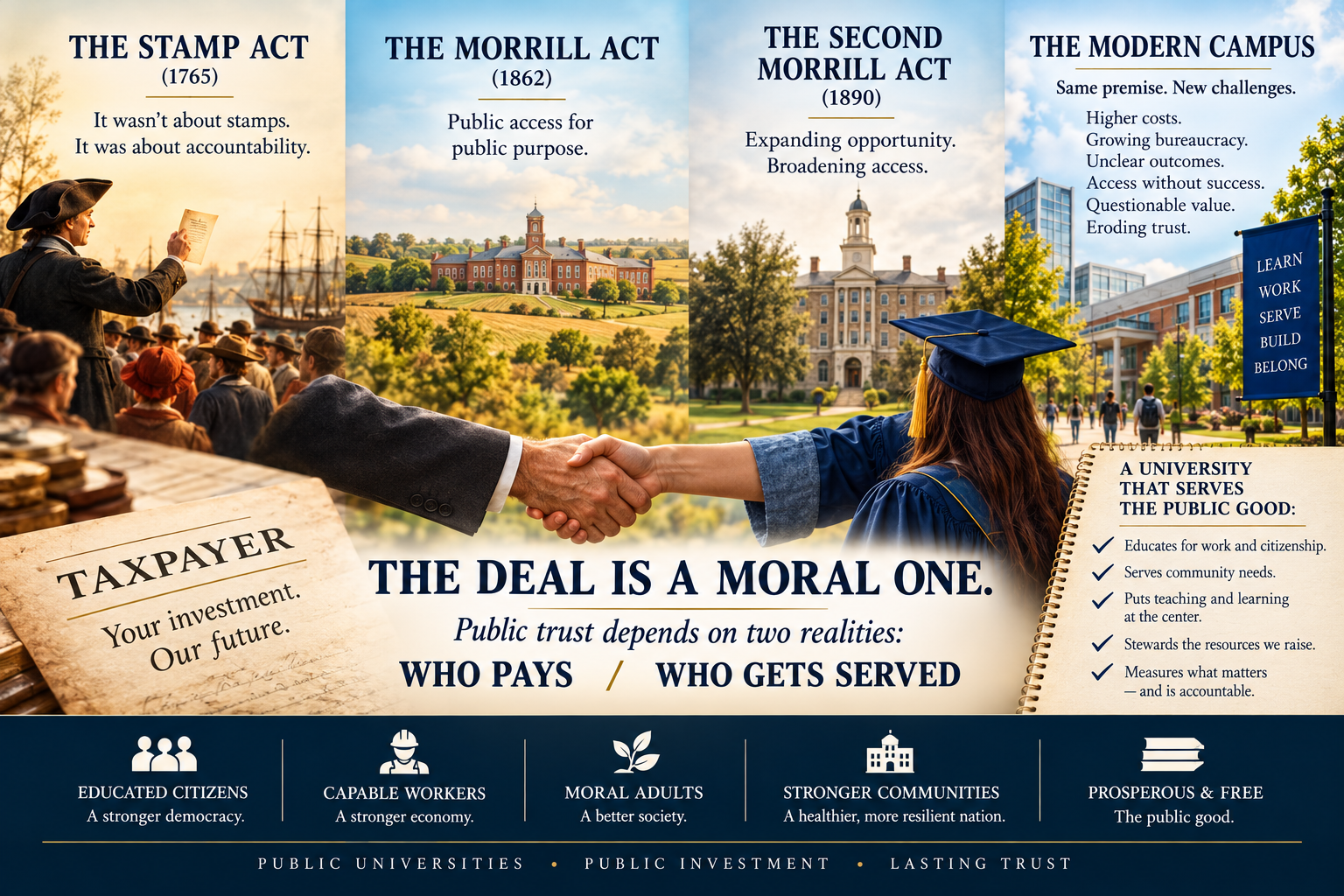
If you want a clean line through the noise, draw it from the Stamp Act (1765) to the Morrill Acts of 1862 and 1890, and straight onto the modern campus. One act triggered rebellion because people were taxed without a real voice. The Morrill Act built trust because public assets were exchanged for public benefit. Together, they offer a simple, unromantic standard for public higher education in the 21st century: public universities survive only by public trust, and public trust is always tied to two realities: (1) who pays, and (2) who is served. While these are economic considerations, they are fundamentally moral. They live at the intersection of political authority and individual liberty.
The Stamp Act wasn’t about stamps; it was about accountability and a lesson in political morality. The colonists weren’t debating office supplies. They were declaring that legitimacy requires representation—that those who bear the cost deserve respect, transparency, and a meaningful say. That same moral logic applies to public higher education. When citizens believe they are paying but not being respected, confidence collapses. It happens when costs rise without explanation, when bureaucracy grows while instruction gets squeezed, when outcomes are cloudy, when access becomes a sales pitch rather than a pathway to success, and when a campus appears more devoted to internal agendas than public purpose. The public isn’t obligated to trust universities. Trust is not an entitlement. Trust is earned, slowly, and it can be squandered in an instant.
If the Stamp Act teaches anything for our moment, it’s this: people will tolerate heavy burdens only if they own an equal measure of voice and value. If families are asked to mortgage their futures while universities avoid candid conversation about cost, value, and outcomes, backlash is not irrational. It is predictable. If the Stamp Act explains how legitimacy is lost, the Morrill Act explains how legitimacy is built. The Morrill Act was a bargain for a constitutional republic: public assets for public purposes. As one of the most consequential public investments in American history, it carried a clear leading object: to promote “the liberal and practical education of the industrial classes” in the pursuits and professions of life. Tied to the significant enterprises of the Industrial Revolution, agriculture and the mechanic arts, while not excluding classical learning, this synthesis may be the greatest single export in the history of the American Experiment. This was the powerful pragmatism of public higher education at its best: broad access, practical competence, civic formation, and visible public benefit. The purpose of these institutions was not vague prestige; it was the elevation of ordinary citizens through education that could be used, education that served communities as it enabled individuals. Driven by economic outcomes, this moral perspective—built on visible public benefit, civic formation, and practical competence—ought to engage and enliven public purpose today. Universities contribute most to the public good when individual aspiration and intellect are pursued in ways that breathe life into the greater social order. That isn’t accidental; it is intentional. When the connection between campus aspiration and community benefit becomes thin, trust is frayed.
Put the two acts together and you get today’s crisis in one sentence: the American public made a deal with its universities, not a legal contract, but a moral one; The Stamp Act reminds us that when people pay and don’t feel represented, or even respected, they revolt politically, financially, and culturally. The Morrill Act reminds us that when public investment clearly yields broad benefit, legitimacy grows.
So, what is the modern university doing with that inheritance?
In too many places, higher education has drifted toward a model where the institution behaves as if it can claim trust rather than earn it. A university that obscures costs, overpromises outcomes, or plunges students into debt without a realistic plan for success is not serving the public good. It is exploiting hope. As a matter of principle, social good shrouded in suffocating debt is theft. That is not rhetorical excess. It is a moral diagnosis. If someone is led, by omission or commission, to believe that any degree, under any circumstances, for any person, is a wise investment, they are misled.
If universities want the public’s confidence again, they must return to first principles. Not slogans. Not branding. They need principles proven in action: tell the truth about cost and value; stop confusing access with success; put teaching and learning on high center; be stewards of the regions we serve; and govern driven by deep principles of stewardship.
The closing question is still: who pays, and who is served?
The Stamp Act and the Morrill Act are not dusty history lessons. They are a mirror. Public higher education has no divine right to exist. It has a duty. The public will support universities that serve the public good with clarity, competence, and moral seriousness. But they will not subsidize drift, denial, and debt—at least, not forever.
In the end, the test is simple and old-fashioned: are we worthy of the public’s trust? If we are, we will show it by what we do, the value we provide, and the impact on those served.
Walter V. Wendler, Professor of the Practice-Higher Education Reform, Bush School of Government and Public Service, President Emeritus, West Texas A&M University and Chancellor Emeritus, Southern Illinois University Carbondale. His weekly columns, with hyperlinks, are available at https://walterwendler.com/.