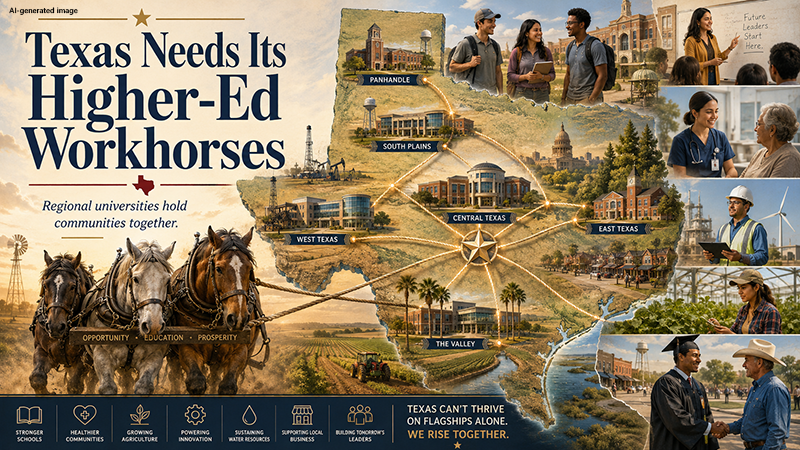
Texas loves a flagship. We should. Flagships and land-grant universities project statewide and national strength, drive major research and help set a tone of excellence. But if Texas wants to stay prosperous, locally anchored and upwardly mobile, we must recognize that regional public universities are the workhorses of Texas higher education. And workhorses don’t pose for pictures; they pull the load.
Across our vast geography, East Texas, West Texas, the Panhandle, the South Plains, Central Texas, and the Valley, regional universities educate the people who keep communities functioning and economies moving. They do it closer to home, with fewer resources and with a practical and moral obligation to serve the people who fund the institution and the region that depends on it. Place matters because life is more than a job. And the values of Texas need to be held to the fore.
In fashionable circles, it’s easy to speak as if people should simply float to wherever opportunity calls. But that misses the texture of real Texas life. A job is not the whole story. An individual belongs to a family; a family belongs to a community; communities form regions and regions help define the character of a state. If higher education forgets that chain of belonging, it becomes abstract and abstraction is a poor foundation for public trust.
Regional universities are built to ensure regional intelligence meets regional needs. In a place like the Panhandle, that means aligning programs and research to what truly sustains the region: agriculture, large-food-animal systems, energy, rural health care, water and the leadership of small school districts. That is not narrow thinking; it is grounded problem-solving. And solutions forged under real constraints often travel farther than ideas developed in comfort.
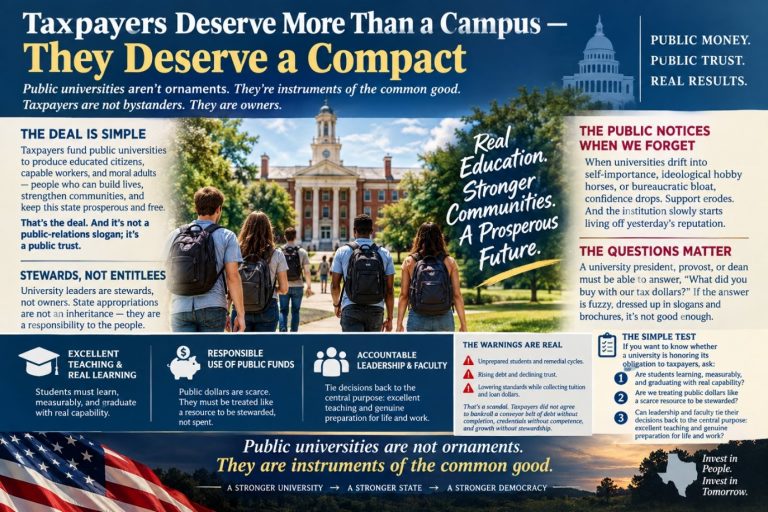
Trust is the currency, the coin of the realm and it must be earned. Public confidence in higher education will not be rebuilt by better public relations. It will be rebuilt by transparency, old-fashioned honesty and visible usefulness.
Texans, especially in rural and regional communities, have a strong sense of social trust and a strong expectation of reciprocity. If a university behaves as though its primary interest is enrollment to preserve the status quo, trust evaporates. If a university behaves like a neighbor, clear about its mission, careful with resources and direct about outcomes, trust grows.
A university is, in the end, a matrix of relationships. Trust is the glue that holds that matrix together. Economic development is real, but it’s not a solo act. Regional universities are often major employers and their spending matters. But the deeper economic impact comes through talent development, workforce alignment and the retention of capable people close to home. Studies have shown that graduates from regional institutions are more likely to settle near where they graduate, exactly what Texas communities need if they want stability rather than a constant brain drain.
But here’s the part policymakers often overlook: universities alone cannot fix struggling economies. Universities can reach out, but communities must reach in. The most effective regional economic development is partnership-driven, with internships, industry collaboration, small business support and education programs designed with local realities in mind. And inside the university, the same rule applies: silos stymie progress. Regional problems don’t respect departmental boundaries, so universities can’t either. The statewide strategy is a tethered system, not a beauty pageant. Texas doesn’t need every campus chasing the same identity. That’s mission creep, and it pilfers purpose, prosperity and progress.
What Texas needs is a tethered interdependent confederation of institutions: community colleges, regional universities and national research universities, each strong in its role, each respecting the others, each contributing to seamless opportunity “up and down the chain.” Higher education is most effective when integrated from high school completion through workforce credentials, bachelor’s degrees and graduate education.
Flagships cannot educate Texas alone. Nor should they be expected to. If we want a stronger Texas, we must stop treating regional universities as an afterthought and start treating them as strategic infrastructure. To elected officials: fund and incentivize regional universities in ways that reward mission clarity, affordability, teaching excellence and measurable regional impact, especially in educator preparation, rural health, workforce needs and applied research that serves Texas communities. To voters: demand partnerships that are real, not ceremonial; invite the university into the region’s hardest problems; and hold it accountable to help solve them.
Texas will always need flagships. But Texas cannot thrive on flagships alone. The regional workhorses do the daily lifting, educate the majority of Texans, anchor communities and sustain the public good.
Regional universities don’t just grant degrees. They hold regions together, welding one to another, and, in doing so, they help hold Texas together with strength in every corner.
Walter V. Wendler is the President of West Texas A&M University. His weekly columns are available at https://walterwendler.com/.