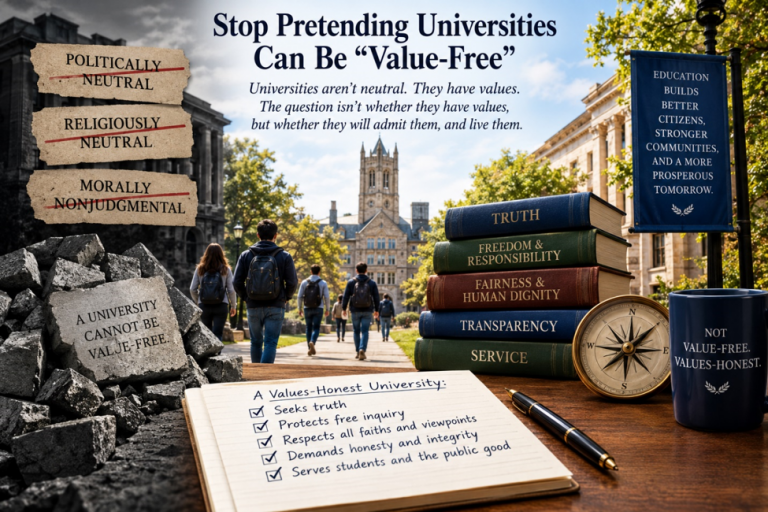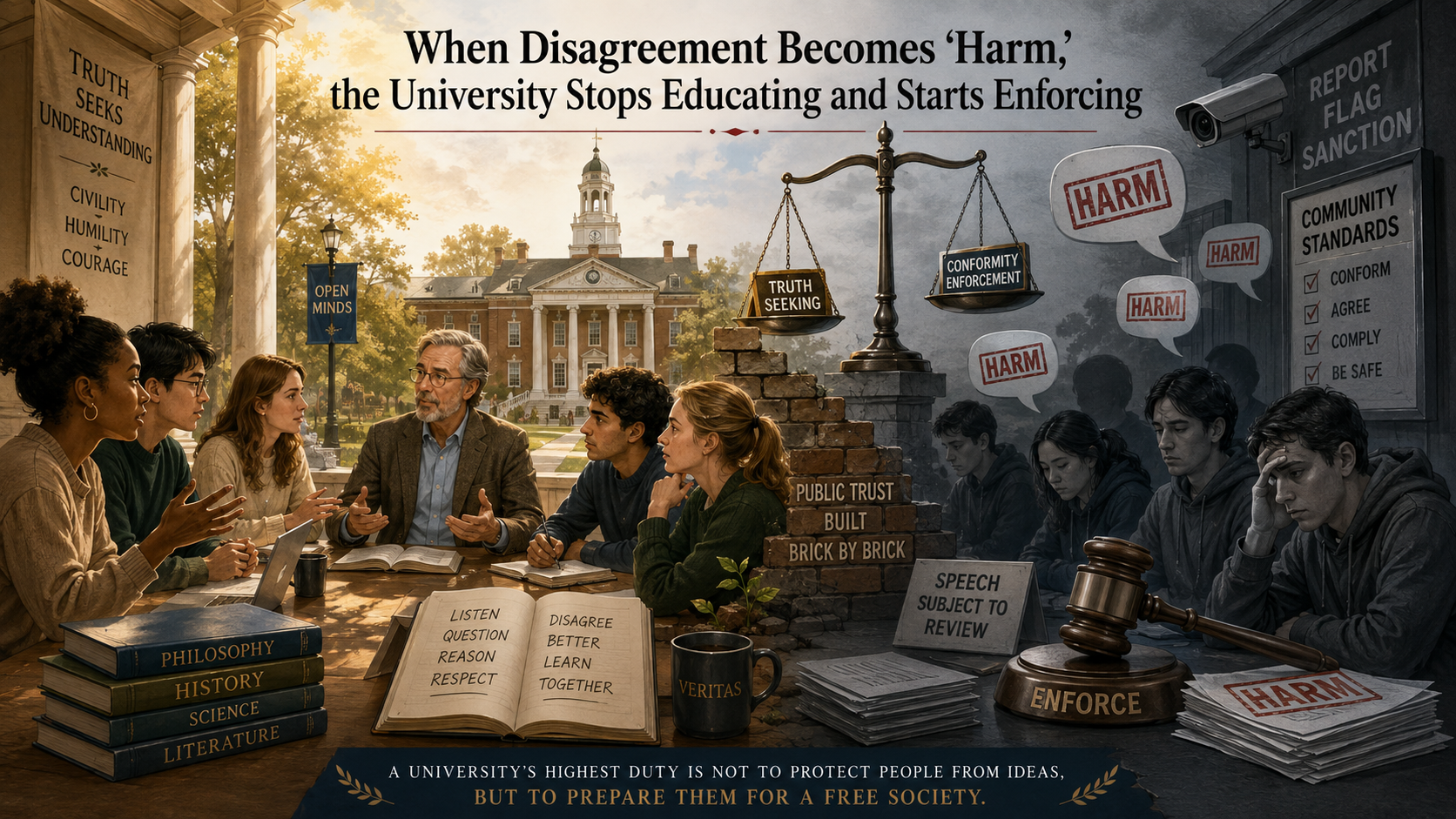
American confidence in higher education is slipping for reasons universities would rather not name. People are not losing faith in learning; they are losing faith in an enterprise that too often confuses disagreement with wrongdoing and then calls that confusion “progress.” When disagreement is mislabeled as harm, the university stops educating and starts enforcing. And once a university becomes an enforcement culture, it forfeits the public trust that makes it worth sustaining.
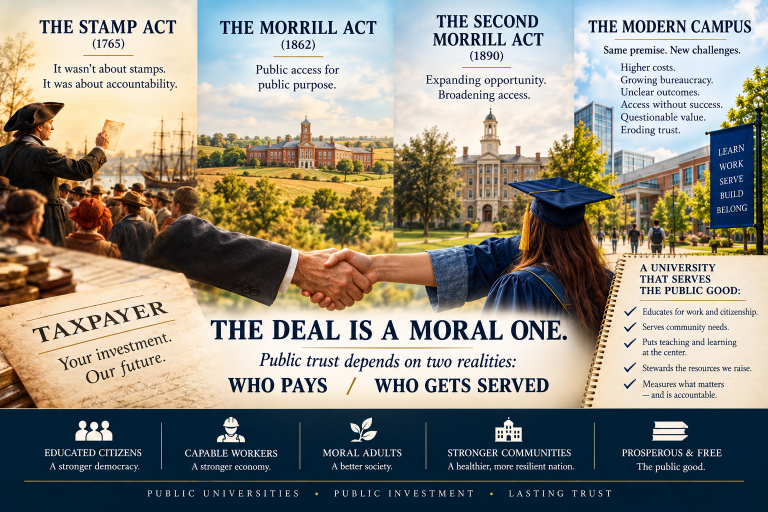
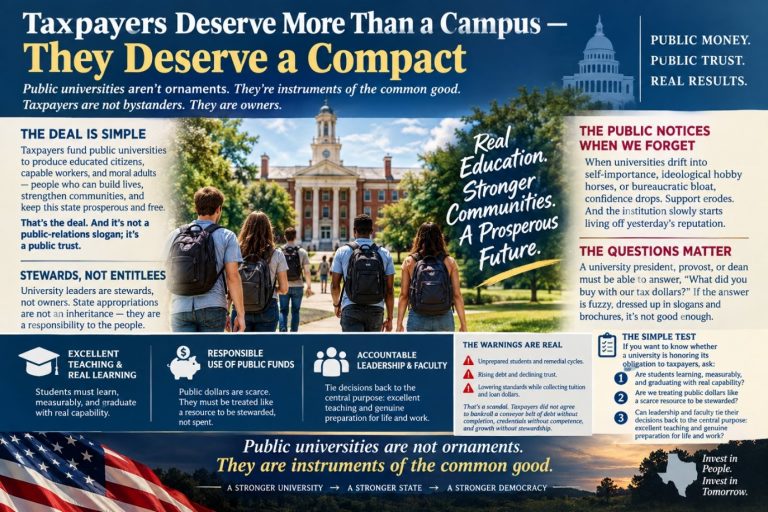
I have argued that public universities live under many microscopes: taxpayers, legislators, parents, employers, and students themselves. That scrutiny is not harassment; it is the price of being a public trust enterprise. Trust, however, does not grow out of press releases. It grows out of transparency, old-fashioned honesty, and directness without apology. And it evaporates when students and the public believe the institution’s interest in enrollment and resources to sustain the status quo is more important than in the hard work of teaching, learning, and forming citizens capable of self-government.
When ideology replaces ideas, it becomes the core and constantly confounding breach of higher education’s purpose. A university’s proper calling is to be a place where ideas can be openly shared and differences in thinking tolerated. Ideas are, by nature, divisive. That isn’t a flaw; it’s the point. The friction of competing claims, tested by evidence, argued with clarity, refined by disciplined scholarship, is how minds are educated. Just ask Galileo and his proposal of a heliocentric universe.
But many campuses have developed “polite” forms of coercion that push in the opposite direction of ideas. I have written that universities show institutional courage by resisting undue external influence and “the inexorable internal tendency toward sameness of thought.” Today, that internal pressure is often the most powerful force. It is harder to identify, harder to confront, and far more effective at producing conformity, because it operates through social intimidation, career incentives, and the quiet threat of reputational damage.
Neglecting this reality does not serve students with ideas, but with ideology.
Conformity may drive out truth-seeking. In a constitutional republic, citizens must be able to disagree without hatred and argue without fear. Universities should be training grounds for that kind of civic maturity. Instead, too many are normalizing a counterfeit agreement enforced by moral language.
Once a campus adopts the habit of labeling dissent as “harm,” several predictable results follow. First, students learn to perform, not to judge. They figure out quickly which opinions are safe to repeat. That is not education; it is conditioning. Second, scholarship bends toward preapproved conclusions. When inquiry begins with the answer, it ends as propaganda, whatever the politics of the day may be. And third, academic freedom becomes selective. I have previously written, “Freedom of speech is a birthright and the heart of citizenship. In contrast, academic freedom is earned, never given.” Academic freedom is the soul of scholarship, yet it cannot survive where certain viewpoints are treated as inherently illegitimate rather than rigorously examined.
The public notices this even when university leaders pretend not to. And the public reaction is not irrational. People will tolerate universities that disagree with them. What they will not tolerate is a university that appears unwilling to allow disagreement to exist within its own walls.
The public’s conclusion: “To hell with the whole mess.” When higher education is perceived as ideologically monolithic, families and students “vote with their feet.” Some avoid public universities. Some leave their states. Some decide college isn’t worth the cost or the cultural contempt they expect to encounter. That is not good for the students. It is not good for the state. And it is not good for the nation.
What to do: rebuild trust the hard way. Universities can recover confidence, but not by scolding the public or polishing the brand. Trust is rebuilt “brick by brick, one decent act after another.” That starts with a few straightforward commitments: protect viewpoint diversity as an academic necessity, not a public-relations slogan; stop treating disagreement as misconduct because civility matters, and conformity is poison; require intellectual honesty everywhere. As I’ve said plainly: “Prevarication, by omission or commission, is immoral, and fritters away the hard-won trust of the republic.” Lead with moral courage.
A university worthy of public support must be more than a credentialing enterprise or a political clubhouse. It must be a place where students are invited, sometimes uncomfortably, to think, test, revise, and grow. That work requires a campus culture that can say, without apology: disagreement is not harm. Disagreement is often the beginning of learning, but it must always be rendered civilly, thoughtfully, and respectfully. And university leadership cannot say that is not our business. It is the only business that matters.
Walter V. Wendler is the President of West Texas A&M University. His weekly columns are available at https://walterwendler.com/.