Liberty isn’t the problem in higher education. Liberty without responsibility is. When rights become weightless, when they cost nothing, require nothing, and answer to no one, universities stop being places of learning and become places of perpetual grievance.
Every few years, Americans ask why confidence in colleges is sinking. Presidents blame politics. Faculty blame legislatures. Legislatures blame “woke administrators.” Students blame tuition. Parents blame loans. Everyone blames everyone, and public trust continues to evaporate.
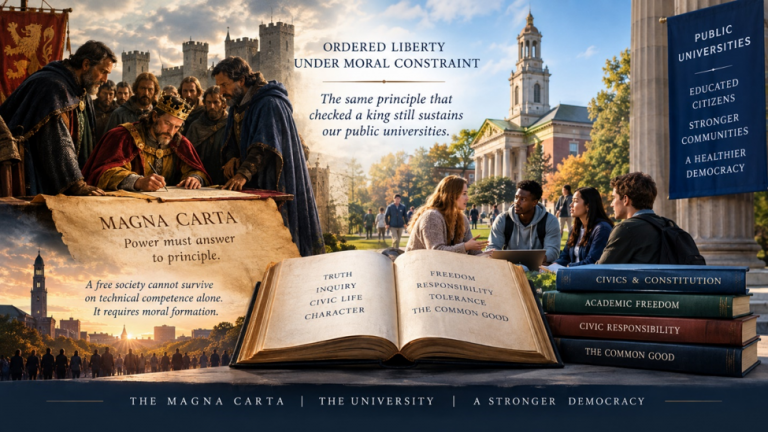
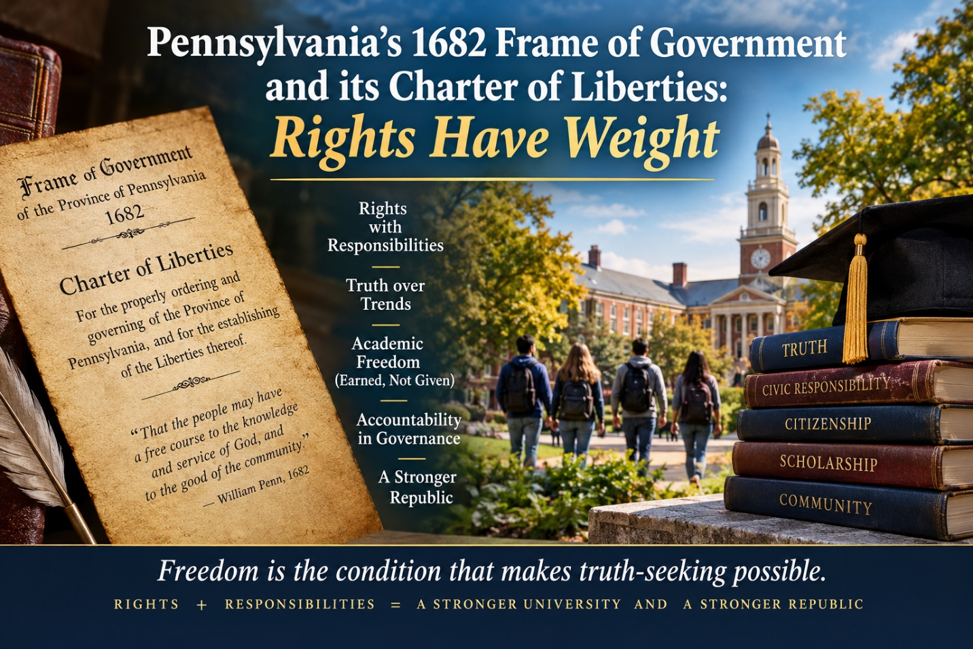
What kind of institution is a university supposed to be in a free society? That question isn’t new. It was answered plainly, without modern euphemism, in early American governing documents, such as William Penn’s, Pennsylvania’s 1682 Frame of Government and its Charter of Liberties. The aim was not freedom as self-expression. The aim was ordered liberty: freedom protected by law, grounded in moral seriousness, and constrained by accountability.
Universities must recover that same architecture: rights fused with responsibilities, mission clarified, and trust earned. Rights without responsibilities create noise, not knowledge. Pennsylvania’s early charter tradition protected conscience, property, and participation, but assumed a simple truth: liberty must serve community, not solely self. That balance is precisely what many campuses have lost.
We now see increasing greediness for rights unattached to responsibilities, in the form of an often-sanctimonious demand to be heard. That mindset, when imported into campus life, turns a university into a complaint department rather than a truth-seeking community.
A university worthy of the name must remember freedom is not the goal; truth is the goal. Freedom is the condition that makes truth-seeking possible. But freedom without discipline becomes performance, not scholarship, volume, not insight. I have previously opined “Let truth adjust the volume of the expression of thought.”
The punchline? The right to speak, the responsibility to seek truth, not attention, legitimate disagreement, are all welded together by the obligation to engage with rigor, evidence, and restraint. Ordered liberty is not fragile because it’s strict. It’s fragile because it requires character.
The campus is not a stage; it’s a moral community, as was Penn’s vision for the Province of Pennsylvania nearly three and a half centuries ago. A free society depends on people who can govern themselves. That requires citizens who understand that rights come with duties. Even in the broader American tradition, as described by JFK in Profiles in Courage, “For, in a democracy, every citizen, regardless of his interest in politics, ‘holds office’; every one of us is in a position of responsibility; and, in the final analysis, the kind of government we get depends upon how we fulfill those responsibilities.” If that’s true for the nation, it’s true for universities.
Universities often talk about “community,” but too frequently mean comfort, not commitment. Yet a real academic community is built on a form of duty: Challenging intellectual work even when it’s unpopular, treating others as neighbors, not enemies, accepting critique without crying oppression and honesty about trade-offs, outcomes, and costs: These concepts are the furnace of community and progress.
Universities drift when they stop forming citizens and start merely managing consumers. A constitutional republic doesn’t run on credentials alone. It runs on citizens capable of reason, humility, and responsibility. “The first duty of a university is to teach wisdom, not trade; character, not technicalities.” Frequently, and incorrectly, attributed to Winston Churchill. That’s not romantic talk; it’s the maintenance manual for the Republic. Academic freedom is real, and it is not a toy. Pennsylvania’s charter spirit also reminds us that liberty must be protected against coercion, from distant authorities and from the mob next door. That maps directly onto academic life.
At their best, universities show institutional courage, the willingness to defend open inquiry by resisting undue external influence and resisting the internal tendency toward sameness of thought. Said plainly, confusion is eating universities alive: Free speech is a birthright. Academic freedom is not. I previously wrote: “Freedom of speech is a birthright and the heart of citizenship. In contrast, academic freedom, is earned, never given.” Academic freedom, the beating heart of the academy, is sustained through scholarship, method, disciplined integrity, peer standards and a commitment to truth that stands apart from fashion. Without responsibility, academic freedom becomes either license or liability, a shield for ideology, not a tool for discovery. Governance is where responsibility either lives or dies; both in the public square, and on campus.
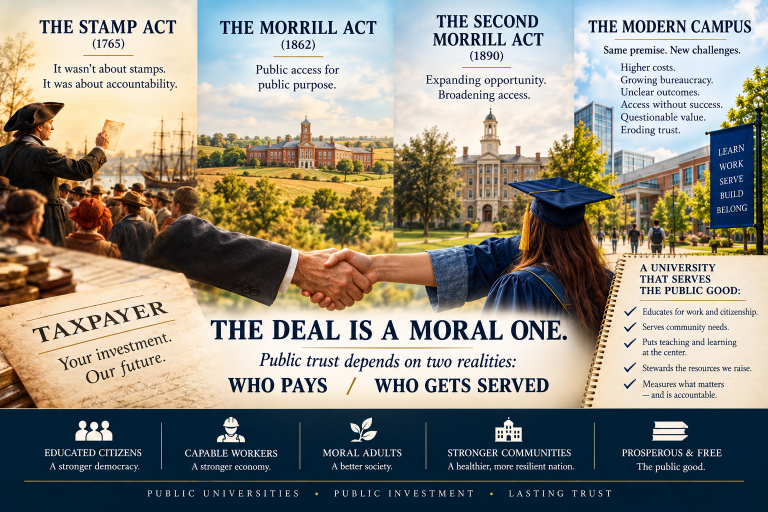
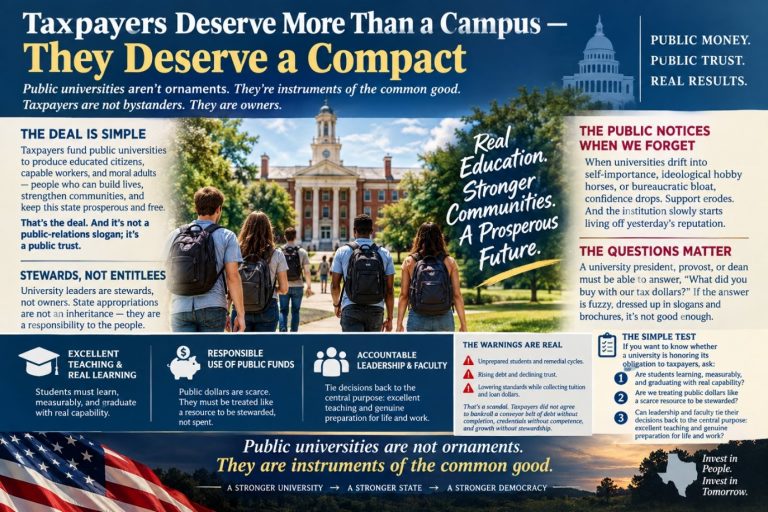
The Pennsylvania model assumed authority must be bounded, transparent, and answerable. That is a bruising lesson for modern higher education, where too many boards and administrations behave as if public accountability is a nuisance rather than a duty. A university is a public good, not a private club with a taxpayer subsidy. When institutions become insulated, when they treat families like ATM machines and the public like an audience to be managed; trust erodes. And trust, once squandered, is not quickly restored.
Responsible governance means boards and leaders must do unglamorous work: tell the truth about costs, cut administrative bloat before instruction, measure outcomes honestly, protect academic standards and refuse to substitute marketing for mission. A university cannot demand the public’s money and reject the public’s questions. That’s not autonomy, that’s arrogance.
Rights have weight. Pennsylvania’s 1682 ideas are not museum pieces. They’re a measuring stick. If universities want renewed trust, they should stop acting surprised that citizens expect accountability. The public is not anti-education when it asks for honesty about cost, clarity about outcomes, and seriousness about truth. The public is doing what ordered liberty requires: insisting that power, any power, be bound by responsibility.
The future of higher education won’t be saved by better branding. It will be saved by better behavior. That’s not nostalgia. That’s survival.
Walter V. Wendler, Professor of the Practice, Bush School of Government and Public Service, President Emeritus, West Texas A&M University and Chancellor Emeritus, Southern Illinois University Carbondale. His weekly columns, with hyperlinks, are available at https://walterwendler.com/.