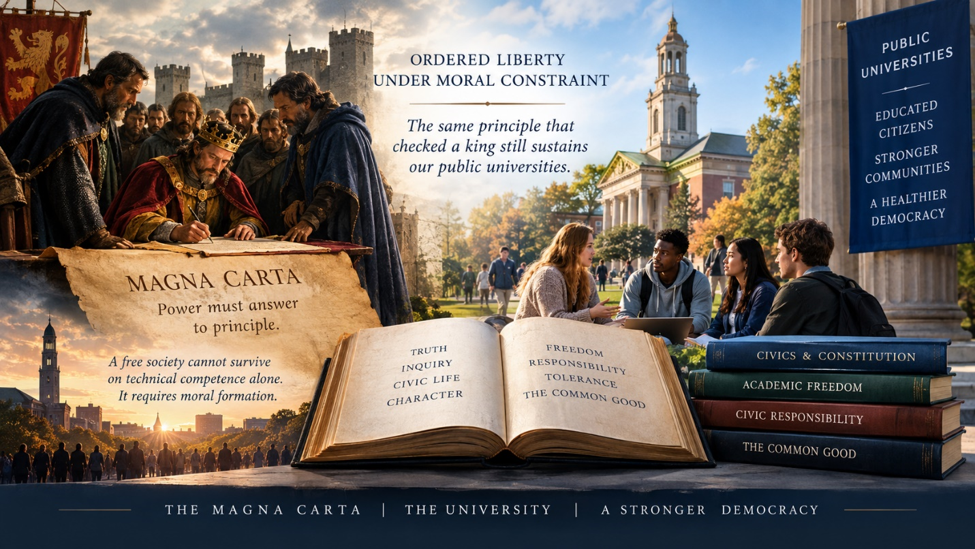
Eight hundred years ago, a group of English barons forced a reluctant king to sign a document that said, in plain terms, power must answer to principle. The Magna Carta wasn’t written for universities. But it helped anchor a tradition that universities cannot live without: Authority must be limited so truth can be pursued without fear.
That idea, ordered liberty under moral constraint, is not a fragment of antiquity. It is the civic soil from which public higher education grows. It is one fulcrum of a positive future for engaged citizens in the pursuit of truth.
And when truth loses, the public notices. Public higher education’s value proposition is civic, not merely economic, moral, not simply legal or bureaucratic. The worth of public higher education cannot be reduced to workforce training alone, not because work is beneath the university, but because citizenship is above mere employability. Universities are meant to produce graduates capable of self-government, a high calling that embraces clarity of reason, civility in discussion, and channel responsibility towards civic purpose.
That civic purpose is exactly what is now strained. Activism replaces inquiry, and institutions pursue social engineering or technocratic solutions rather than forming wise and virtuous citizens. That is not just a cultural problem. It is a civic crisis because a republic depends on institutions that teach the habits of liberty.
Here is the hard truth: a free society cannot survive relying on technical competence alone. It requires moral formation, restraint, honesty, courage, humility, and responsibility. I have previously reflected: “Liberty for free thought fused with free will is the foundation of a free society. Nothing else works.”
Why think about the Magna Carta today nearly a millennium after it was penned?
We should stop defending universities as if they are fragile luxuries for elites and start defending them as public trusts that survive and thrive on earned confidence. Recognizing that tradition should lead public universities to recommit to a few straightforward obligations: Teach civics and the constitutional order as part of general education, not as an optional elective; Defend academic freedom and free inquiry by resisting external political control and internal ideological uniformity; Reconnect freedom to responsibility, so rights do not become a weapon against the learning environment itself. And trust is earned when universities behave like what they claim to be: institutions devoted to truth, education, and the common good.
The Magna Carta is a reminder that the West’s best institutions were built on a stubborn belief: no person and no institution is above accountability. If public higher education wants to reclaim its societal calling it should begin with humility, with courage, and with a renewed commitment to the disciplined freedom that makes learning possible.
And if we want to reclaim the purpose of public universities, we would do well to remember where the public’s expectations come from: not from marketing slogans, not from rankings, and not from the latest ideological fashion, but from a long tradition that insists institutions exist to serve the common good and to do so with integrity.
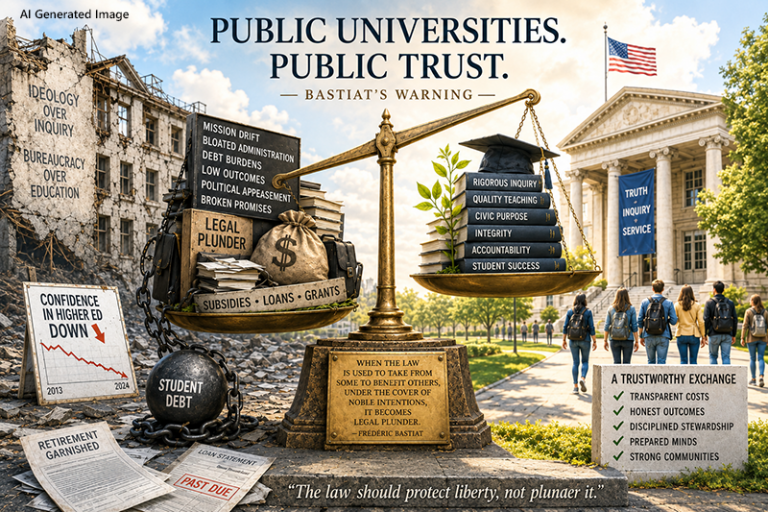
Universities now face a crisis that is deeper than budgets or demographics. It is a crisis of mission and public trust. Higher education is at a crossroads, in part because the public increasingly senses that universities are drifting from their rightful purpose, forming educated citizens, cultivating wisdom, serving communities, toward something narrower and more self-referential. Trust, once lost, is difficult to regain. As Thomas Paine warned in the Rights of Man, “a body of men holding themselves accountable to nobody ought not to be trusted by anybody.” Public universities cannot afford to appear to be beyond accountability.
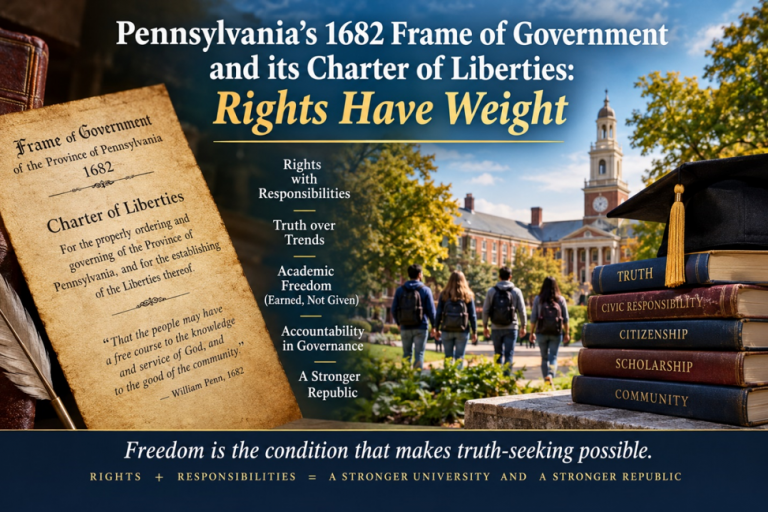
Rights without responsibilities are not liberty but empty emotion.
The public’s frustration with higher education is not always eloquent, but it is often perceptive. People see campuses where the message of “rights” is loud and constant, yet the language of responsibility and restraint seems faint. Truth-seeking requires space for quiet, rigorous and thoughtful disagreement. This is where the Magna Carta mindset matters. The document is a reminder that freedom is not simply the removal of all limits; it is the placement of limits where they belong, on power, coercion, and tyranny, so that ordinary people can live, speak, worship, work, and learn. When a university forgets this, it becomes vulnerable to a new form of coercion: not always from a king, but from what some call the “body politic,” the demand that certain ideas must be protected from scrutiny and others must be punished for being spoken.
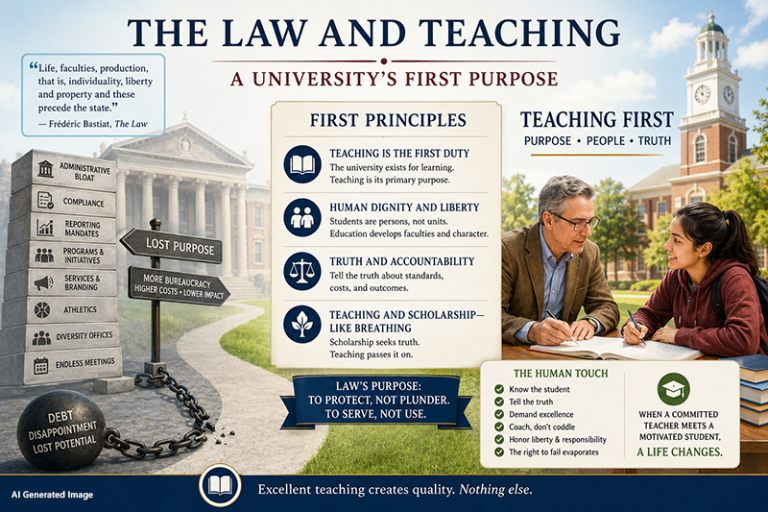
The university’s job is not activism. It is inquiry anchored in moral seriousness. A university should be a place where ideas can be openly shared and differences in thinking safely tolerated. That is not a partisan claim; it is an academic one. I have argued that at their best, universities show “institutional courage” by resisting the inexorable internal tendency toward sameness of thought.
That line matters because many universities now suffer from pressure from both directions. Legislators and interest groups sometimes try to dictate curricula. But universities also suffer from internal forces, bureaucratic, cultural, and ideological, that narrow acceptable thought. Either way, the result is the same: education becomes less about forming minds and more about enforcing conformity.
Alexis de Tocqueville, Democracy in America, remembered what many modern institutions forget: institutions survive only when anchored by firm moral principles, and those principles should be openly and civilly discussed inside and outside the institution. When the university drifts from those principles, even slightly, it begins to serve the interests of influence rather than purpose.
Walter V. Wendler, Professor of the Practice, Bush School of Government and Public Service, President Emeritus, West Texas A&M University and Chancellor Emeritus, Southern Illinois University Carbondale. His weekly columns, with hyperlinks, are available at https://walterwendler.com/.