Public Universities, Public Trust—and Bastiat’s Warning About “Legal Plunder”
Second in a series on Public Higher Education.
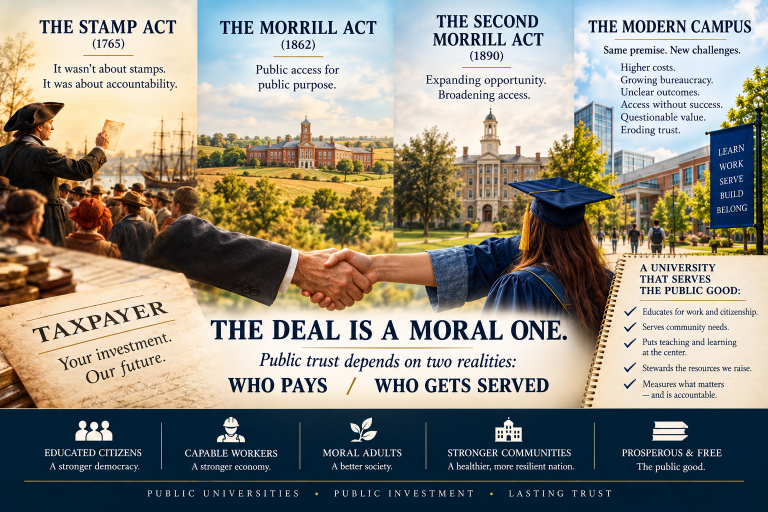
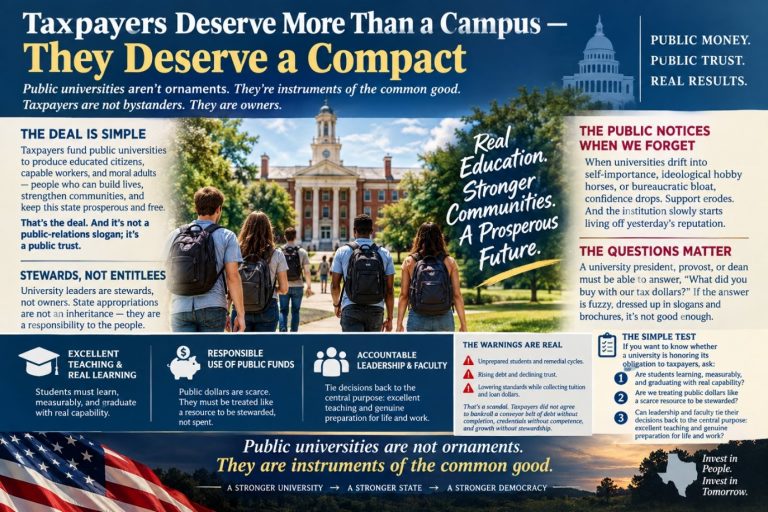
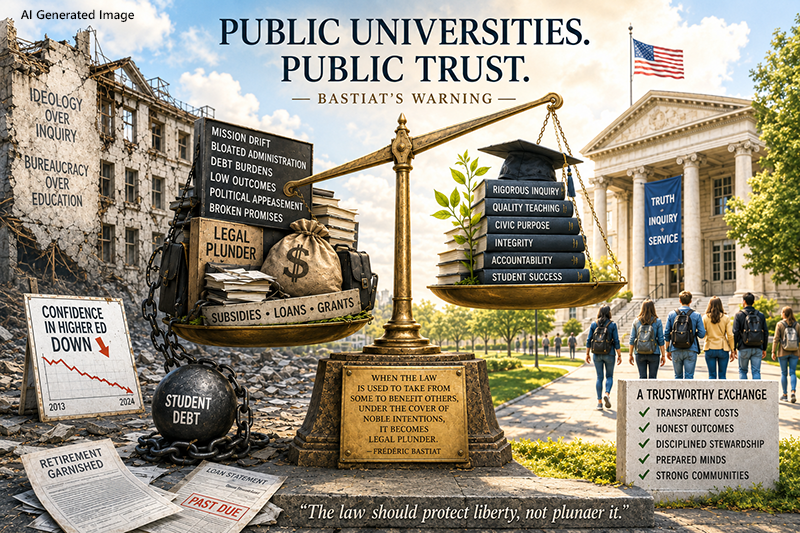
Frederic Bastiat’s The Law is a slim book with a heavy message: when the law is used to take from some to benefit others, under the cover of noble intentions, it becomes legal plunder. Bastiat wrote in the language of 19th-century France, but his moral logic lands squarely on 21st-century American higher education. Public universities are not merely institutions; they are public trusts, supported by citizens who expect something concrete in return: educated people, civic stability and economic vitality.
That’s the premise I come back to again and again: public universities must earn trust, not demand it. And if that trust is squandered, everything downstream erodes: appropriations, philanthropy, enrollment confidence and the moral authority needed to set standards and tell hard truths. An organization can’t “message” its way out of a trust deficit: it must lead its way out.
The new campus temptation: mission drift dressed up as virtue, and promises devoid of purpose, are empty.
Today, higher education faces rising skepticism, high costs and demands for accountability reports, Pew. Many leaders respond with branding, slogans and a new “strategic plan” every few years, often because presidential turnover is constant and institutional memory is short. But trust is not built through public relations. It is built through transparency, old-fashioned honesty and directness without apology. When students and families suspect that the university’s primary motivation is feeding the bureaucracy rather than serving the learner, trust evaporates.
And here’s the uncomfortable connection to Bastiat: when an institution funded by taxpayers stops delivering its core mission and instead protects itself: its headcount, its pet programs, its political appeasements, public funding begins to look less like public investment and more like plunder defended with paperwork.
Bastiat would recognize the pattern. The university says it is acting for the public good, while the outcomes tell another story: rising administrative growth, debt burdens, diluted standards and commitments that quietly exceed capability. Inside Higher Ed reports that trust evaporates if students believe the university’s interest is based on the need for enrollment and resources to sustain the status quo. That is not merely a management problem. It’s a moral problem. Good intentions become institutional deception.
One of the most corrosive examples is the recruitment of students who are not ready for college-level work, according to Baltimore PBS, financed by loans they may carry all the way to the Social Security office. One in ten of student borrowers are having retirement check garnished to pay student loans according to the Consumer Financial Protection Bureau. Such action is disgustingly defended as access and compassion. But compassion without truth is cruelty wearing Sunday clothes, all the way to the grave.
Admitting unprepared students simply because they arrive with loan dollars is “misleading and a form of lying and cheating.” Why? Because it turns a student’s hope into an institution’s revenue stream. Bastiat’s alarm bell rings here: using public mechanisms (subsidies, loans, grants) to sustain an enterprise without honest alignment to outcomes is a kind of legalized moral hazard, otherwise called larceny.
And we do it while singing hymns. Some leaders repeat the mantra that the debt is worth it, while ignoring program-level results, time-to-degree and employability, claims the Lumina Foundation . Meanwhile, the public watches and their disapproving judgment is not irrational. Gallup’s confidence numbers, even with a slight recent uptick, have dropped dramatically over the last decade. That decline is not simply ideological; it reflects skepticism about competence, capability and accountability.
Leadership is the forgotten lever of integrity. Bastiat insisted that legitimate authority is bounded by moral purpose. In higher education, boards and presidents must function as moral stewards, not ceremonial figureheads. Yet too often, governance is weak, politicized or timid, producing bloated and directionless institutions. Administrative staffing has grown substantially, while tenure-track faculty lines have remained flat. That imbalance doesn’t happen by accident; it signals leadership that avoids hard choices.
When boards tolerate cronyism, opaque executive compensation, or growth-without-grounding, new buildings, new debt, new initiatives, while enrollment declines, injure institutional credibility and it’s infecting the whole enterprise. Universities drift from mission to marketing, confusing activism with inquiry and bureaucracy with governance. The result is predictable: loss of mission clarity and loss of trust.
Bastiat would say: if the mechanism is public, the justification must be public as well. If taxpayers are compelled to support the enterprise, then the enterprise has a duty to show disciplined mission performance. Otherwise, the public rightly concludes that the law has been harnessed to subsidize something other than the common good.
The remedy is not spin. The remedy is courage.
A public university worthy of the name must recommit to being a civic institution: one that teaches humility, protects rigorous inquiry and forms citizens capable of liberty. A republic depends on institutions that form minds and hearts for self-government. When universities forget that, they lose purpose and the public’s patience.
So, here’s the punchline, in Bastiat’s moral grammar: public higher education must never become a refined system of legal extraction, taking dollars, time and hope while returning ambiguity. It must be a trustworthy exchange: transparent costs, honest outcomes, disciplined governance and an unwavering mission. Trust takes decades to earn and can be squandered in a season. The university’s job, especially the public university, is to live as though that sentence is true.
Walter V. Wendler is the President of West Texas A&M University. His weekly columns are available at https://walterwendler.com/.