Seventh in a series on Public Higher Education.
Frédéric Bastiat warned that when the law is bent from its rightful purpose, to protect life, liberty and property, it becomes an instrument of legal plunder. That phrase is sharp because the danger is real: public power can be used to take from one citizen to give to another, not for justice, but for politics; not for the common good, but for someone’s gain.
A public university is one part of education spending, the largest financial commitment the state makes, according to reports from the Comptroller’s office. Health and Human Services is next in line. Public Universities sit at the intersection of tax dollars, private ambition and the next generation’s hopes. If we’re going to ask citizens, many of whom never attended college, to fund universities, we owe them something more honest than slogans. We owe them proof.
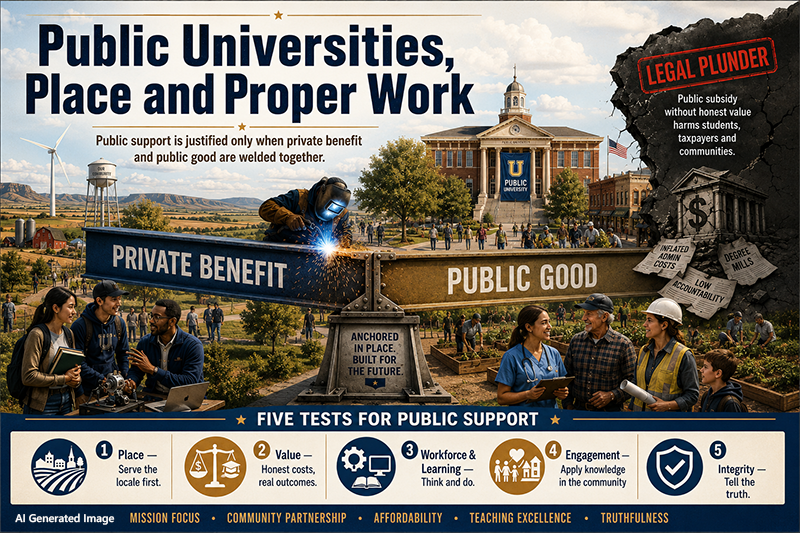
And here is the proof that matters most: a sound university education welds private benefit to the public good, or it is not worth public support. The bargain: private gain and public good, welded together like two pieces of steel. Let’s say the quiet part out loud as the College Board does: a degree has private value and adds, on average, 60% more annually than high school graduates. The lifetime earnings and personal opportunities that follow education are inarguable. People pursue college because they want work that is meaningful, stable and better compensated.
Public support is justified only when the institution returns something that citizens broadly share: economic vitality, civic stability and a stronger culture of self-government. Regional institutions, especially, are built for this. They are not boutique amenities. They are “workhorses of opportunity,” reports the IZA Institute of Labor Economics. Their success is measured not only by the individual transcript, but by whether the region becomes more capable, more resilient and more prosperous.
That’s why place matters. It is not something to apologize for. It is the genesis of mission and service. A university shorn from its region is not elevated; it is diminished. Isolation might fit a monastic purpose; it does not work for a public university. As Whitehead put it: “Celibacy does not suit a university. It must mate itself with action.” If we carefully shield the university from the life of the world around it, we chill interest and defeat progress.
Economic development isn’t a side hustle. It’s central to purpose. In rural America, a regional university is often the steadiest large institution for a hundred miles. It educates teachers and nurses, engineers and accountants, business owners and public servants. It is frequently a major employer. It seeds research and practice that fits the texture of local industry, agriculture, energy, rural health, small manufacturing, logistics and education leadership in small school districts.
And regional development does not come mainly from mega-projects and flashy subsidies. It comes from lots of smaller, locally defined actions with local partners, especially small businesses, the “Main Street” enterprises that carry communities through hard years and good ones. Regional universities ought to be “driving the bus” in helping these communities produce both private and public benefit, reports Higher Ed Dive.
But notice what makes this work: not bureaucracy, not slogans, but partnership. Universities can reach out; communities must reach in. It’s a two-way street, and when it’s healthy, it becomes like a marriage: the health of one partner depends on the health of the other.
The real enemy: “legal plunder” disguised as education is a pressing challenge. Bastiat’s warning applies to higher education in a painfully modern way. If universities use public subsidies and federally backed loans to enroll students they know are unprepared, push them through programs of dubious value and leave them with suffocating debt, then we are not practicing opportunity. We are practicing something closer to theft dressed up as compassion.
Social good shrouded in suffocating debt is theft. When institutions feed their bureaucracies while students bear lifelong financial wounds, the law’s protective function has been inverted. That is precisely the kind of moral disorder Bastiat was describing: public mechanisms used to create private winners and socialized losses. This is how public trust is squandered, not in one dramatic collapse, but in a thousand small evasions. And trust, once broken, is not repaired by marketing. It is repaired by truth.
A framework for policymakers: five tests for whether a university deserves public support. If public funding is a bargain, then leaders and lawmakers need a way to inspect whether the bargain is being honored. Here are five practical tests, grounded in what a regional public university must be.
First, Place Test: Does the university serve its locale first?
A university “not committed to its geographic locale is not worth attending,” and not worth funding. Place-based mission is not parochial; it is relevance.
Second, Value Test: Are costs and outcomes honest and aligned?
No family should ever say, “It is worth it no matter the cost.” That’s propaganda. Public support should follow institutions that control cost, reduce time-to-degree and produce graduates with real skills and real opportunity, without predatory debt.
Third, Workforce and Learning Test: Does it teach students to think, and to do?
The false split between liberal learning and vocational skill is a mirage. Universities must graduate students who can reason, write, calculate and work; citizens with competence, not just credentials.
Fourth, Engagement Test: Is knowledge applied, or merely stored?
“Unapplied knowledge is knowledge shorn of its meaning.” Look for internships, applied research, service learning, teacher preparation partnerships, industry advisory boards and evidence that the campus and community are mutually strengthening.
Fifth, Integrity Test: Does it tell the truth, especially when painful?
Universities rebuild trust through transparency and truth, not defensiveness. Measure whether leaders confront failure, repair weak programs, demand teaching excellence and stop hiding behind complexity.
Bastiat wasn’t anti-government; he was anti-corruption of purpose. He believed the law must do justice, not redistribution-by-favor. In that light, the highest defense of a public university is not sentiment. It is moral clarity and measurable service. If a public university makes a region stronger, economically, civically and culturally, then public support is not plunder. It is an investment in the very conditions that make liberty sustainable. But if a university becomes untethered from place, indifferent to cost, evasive about outcomes and addicted to prestige politics, it has broken the bargain. And when the bargain is broken, taxpayers are right to ask hard questions.
The path forward is not complicated. It is just demanding mission focus, community partnership, affordability, teaching excellence and truthfulness, so that private benefit and the public good remain welded together, not merely promised in speeches.
Walter V. Wendler is the President of West Texas A&M University. His weekly columns are available at https://walterwendler.com/.