Fifth in a series on Public Higher Education.
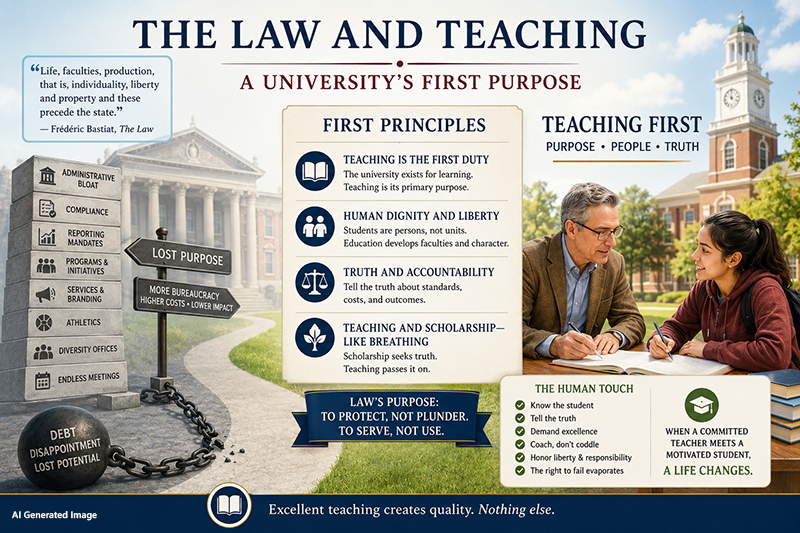
Bastiat’s brief but powerful book, The Law, is bracing because it does not allow us to hide behind complexity. He begins with a moral first principle: human beings are born with “life, faculties, production, that is, individuality, liberty and property and these precede the state.” These are natural rights, and God-given, said he. Law, therefore, is not a tool to manufacture virtue or outcomes; it is an instrument to protect what already belongs to persons by nature. When law departs from that purpose, Bastiat argues, it becomes “perverted”: it turns from protection to plunder, from restraint of injustice to the organized redistribution of responsibility. That framework, properly translated into the university context, helps explain the insistence of teaching as the first obligation, and why the human touch is not nostalgia but necessity. Teaching is the legitimate purpose of the university.
If we take Bastiat seriously, the first question is always: What is the institution for? Plainly: the university’s first purpose is learning, and learning’s primary instrument is teaching. Cardinal John Henry Newman relentlessly promoted this in The Idea of a University. Everything else exists to support that aim. When teaching is treated as a secondary activity, beneath research, prestige, bureaucratic compliance, branding, athletics, or a swelling list of “services,” the institution has committed the same kind of inversion Bastiat warns about in law: it has substituted mechanism for purpose.
Bastiat insists that once law becomes an engine for aims beyond its legitimate scope, it will expand without end, because every faction will compete to use it for its own objectives. Universities face a parallel temptation. If the institution is no longer ordered toward teaching and learning, it becomes a platform onto which we bolt new obligations endlessly: programs, offices, mandates and reporting structures, each justified as compassionate, strategic, or modern. The result is what the public experiences as administrative bloat and what students experience as higher cost and diluted attention. Bureaucracy becomes a “twisted first purpose,” living outside the watch like a wicked watchmaker; busy, growing and often disconnected from what matters most. And, as Admiral Hyman Rickover opined, “If you are going to sin, sin against God, not the bureaucracy. God will forgive you but the bureaucracy won’t.”
Bastiat’s most famous warning regarding legal plunder: when the state uses law to take from some to give to others, not as justice but as policy, often dressed in moral language. The university version is not identical, but it rhymes. When institutions enroll unprepared students with little chance of success, sustain themselves on federally insured loans and then celebrate access while students leave with debt and no degree, we have taken something precious: time, money and hope, and returned too little. It is theft shrouded in social good. Our universities are too frequently bedeviled by the seemingly benevolent belief that procedural rationality creates quality. Excellent teaching creates quality, nothing else. The Lumina Foundation gets it and places teaching as a clarion call, a contemporary cry, for excellent teaching.
The moral danger is magnified when plunder is organized and normalized, when it becomes “the system.” That’s why it’s so challenging to have good intentions unmoored from clear purpose. A university can persuade itself that it is serving the common good while it quietly shifts risk onto the student and taxpayer. And once that pattern sets in, it produces a corrosive downstream effect: the public loses trust, students lose confidence and the institution responds, not with renewed devotion to teaching, but with more layers of management, more messaging and more machinery.
“Life, faculties, production”: education is about developing persons, not managing populations. Universities exist to develop faculties: reasoning, judgment, skill, character and the ability to contribute productively. That cannot be mass-produced by policy. Which brings us to the most direct solution: the cure for many institutional ills is profoundly simple, a concerned teacher working directly with a motivated student.
Public universities now serve increasingly complex student populations: older students, working parents, veterans, first-generation students, underrepresented students, transfers, students carrying academic gaps and life burdens, according to the Education Data Initiative. Systems matter, but systems cannot substitute for judgment and judgment is exercised by persons. The state trying to do everything through centralized design has an academic cousin: the university that tries to guarantee outcomes through bureaucracy inevitably diminishes the dignity and agency of the very people it claims to help.
The human touch is where Bastiat’s anthropology meets educational reality. Students are not units to be processed; they are persons with moral agency. A teacher who knows a student, who tells the truth about performance, who demands excellence, who refuses to inflate grades (because grade inflation is lying), who coaches rather than coddles, honors the student’s liberty and responsibility. That is not softness; it is respect. The Right to Fail evaporates.
Teaching and scholarship: “like breathing,” not a prestige hierarchy.
Some will object, but research and scholarship matter. Yes, absolutely. I reject the false choice. Strong teaching and strong scholarship are not enemies; they are like breathing. Scholarship is the pursuit of truth; teaching is the disciplined transfer of the habits of truth-seeking to students. When an institution forgets its legitimate purpose, it begins to reward the wrong behaviors. If prestige, promotion and institutional energy drift away from teaching, then even good faculty will respond rationally to incentives, and the first obligation will steadily weaken. A Bastiat-like conclusion: simplicity, limits and moral seriousness on primary purpose is essential. The institution cannot become every service provider, every rescuer, every ideological referee, every credentialing machine, every entertainment venue and still remain excellent at teaching.
The university’s first duty is teaching. Its first moral relationship is teacher-to-student. Its first public trust is to tell the truth about standards, costs and outcomes. Universities that apply those first principles restore both effectiveness and legitimacy. And when a committed teacher meets a motivated student, day after day, something happens that no bureaucracy can manufacture: a life changes. That, in the end, is the real work.
Walter V. Wendler is the President of West Texas A&M University. His weekly columns are available at https://walterwendler.com/.