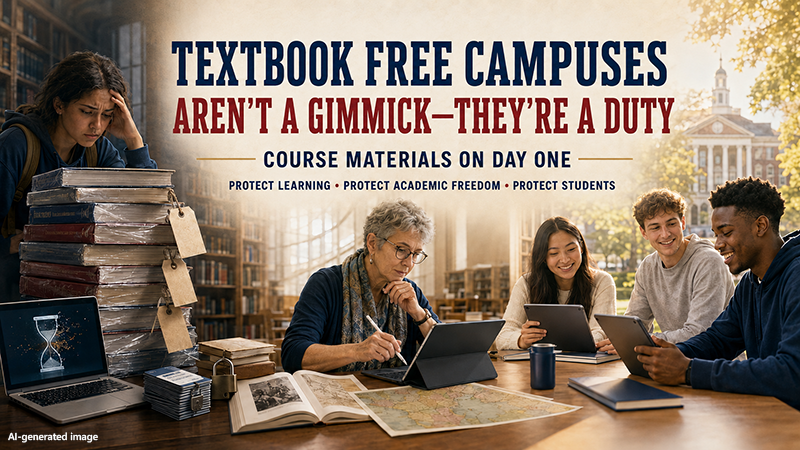
Universities can talk about affordability until they are blue in the face, but students know the truth the moment a syllabus drops: the real cost of college is not only tuition. It is also the parade of “required” course materials—new editions, bundles, one-time codes and digital access that expires as if learning had an end date.
In 2018, I wrote an essay titled “Textbook‑Free, Not Free Textbooks.” The point was not to declare war on books. The point was to defend students from a marketplace that too often treats them as captive customers. And the point was to defend teaching from a model that quietly transfers curricular control from the faculty member in the classroom to an editor and a sales force hundreds of miles away.
The case for digital textbooks and digital course materials is even stronger today, and it is stronger across every major and at every level, from freshman composition to upper-division engineering and on into doctoral studies. Why? Because we have reached a moment in American higher education where the cost/value equation is no longer a debate topic. It is the central test of whether the public can trust us.
Textbook costs have risen at a pace that should embarrass anyone who claims to be an honest steward of student resources. A U.S. Government Accountability Office report determined that textbook costs rose 82% between 2002 and 2012. When students borrow to pay for those books, because many do, those costs metastasize. Borrow $6,000 for course materials and finance it over 20 years at 7%, and the student pays more than $11,000. That is not a footnote. That is a real burden attached to an education that universities claim will liberate.
We should stop pretending this is harmless. It is not.
Some will say, “But quality matters.” Yes, it does. Quality is the entire point of a university. But the assumption that a high-priced, bundled product is automatically higher quality than faculty-curated resources is lazy thinking and universities cannot afford lazy thinking.
Open Educational Resources and other digital materials allow faculty to design courses around the best available content. Open-access resources, publicly available, allow a faculty member to organize a set of intellectual resources into an effective syllabus. Rather than an editor in New York, Los Angeles or Chicago deciding what the course should contain, the person teaching the course decides exactly what to use. That is not a minor operational detail. That is academic freedom.
Consider something as ordinary as American History 101. If the War of 1812 is a unit in the course, one Google search produces tens of millions of citations. Even if a tiny fraction has value, there remain thousands of usable resources—primary sources, scholarly essays, maps, debates and data. A diligent faculty member can curate what is relevant, discard what is junk and build a course that is more current and more demanding than a one-size-fits-all commercial text.
And, importantly, students can have those materials on day one.
That “day one” point matters more than many administrators realize. When students cannot afford the materials, they do not simply shrug and learn anyway. They start behind, they fall behind and they too often drop a course, withdraw or change their plans. A university that talks about student success but ignores the predictable impact of course material costs is like a farmer who prays for rain but refuses to fix the irrigation line.
A “textbook‑free” campus is not a campus where nobody reads. It is a campus where the institution refuses to tolerate unnecessary costs that block access to learning. It is a campus that treats students as people with budgets, families and responsibilities – not as revenue streams.
To be clear: digital materials are not automatically cheaper and not automatically better. I have noted that digital materials do not always outperform traditional texts. That is precisely why faculty judgment matters. The goal is not to chase novelty. The goal is to practice stewardship: to select materials that achieve the learning outcomes and to do so without imposing needless financial harm.
What should universities do? First, support faculty in adopting or building OER and curated digital course packs. Second, expand library-licensed digital resources and reserves. Third, where appropriate, negotiate campus-scale agreements that provide digital textbooks and platforms broadly—without surprise fees and without student-hostile expiration schemes. Finally, be transparent: tell students the true cost of attendance, including course materials, before they register.
Higher education will not regain public trust through slogans. It will regain trust through visible, practical decisions that put students first. “Textbook‑free, not free textbooks” remains a simple idea: protect learning, protect academic freedom and protect students from avoidable debt.
That is not radical. That is responsible. And responsibility, quietly, stubbornly practiced, is what will preserve the best of the American university.
Walter V. Wendler is the President of West Texas A&M University. His weekly columns are available at https://walterwendler.com/.