Eighth in a series on Public Higher Education.
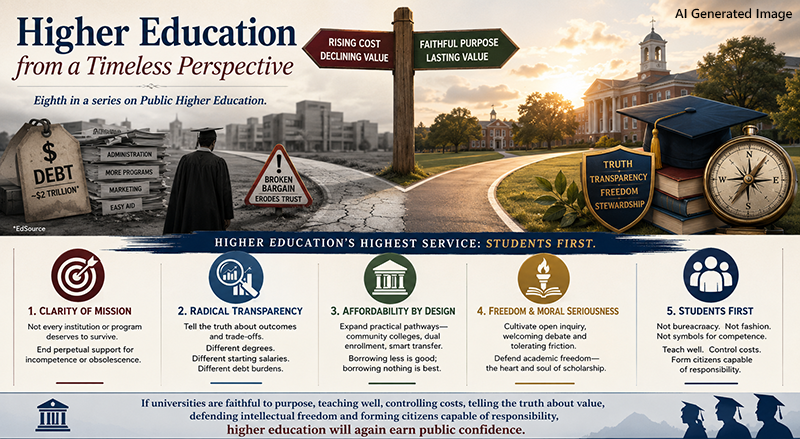
Higher education in the 21st century stands at a cost–value crossroads. For much of the last century, especially after the G.I. Bill and robust state support, college was broadly accessible and reasonably priced. But as state appropriations declined and tuition became a larger share of university budgets, we crossed a threshold where families effectively began paying for “public” universities as if they were private purchases. Meanwhile, student debt climbed toward $2 trillion, says EdSource, with many borrowers carrying obligations into old age. The hard truth is this: when the cost rises faster than the value delivered, public trust erodes and no amount of marketing can repair a broken bargain.
A Bastiat-minded reader would ask a simple question: What is seen, and what is unseen? The seen is the new building, the expanded administrative structure, the glossy brochures, the swelling menu of programs and the easy availability of federal aid. The unseen is more sobering: the graduate whose salary does not match the debt, the student who drops out owing thousands with no degree, the family that postpones homeownership and children and the quiet moral hazard created when institutions can say “yes” to unprepared students because subsidized and insured are in their backpacks. I’ve argued that institutions share responsibility for that debt burden when they enroll students unlikely to succeed, especially when doing so is financially convenient. Institutional honesty is required, as I have written in The Conversation.
The modern university has also been tempted by a dangerous consumer logic: the idea that a degree is a product with value independent of the student, like a pickup truck driven off the lot. But education is not a commodity; its value depends profoundly on student effort, preparation, discipline and follow-through. When public policy treats college as “free” in the consumer sense, it too often dismisses the student’s role as co-producer of value. Universities, for their part, must pursue lower costs and higher effectiveness, but they must also be candid: no university can guarantee happiness or even success. Employment and earning capacity require real competence; fulfillment is a deeper matter of character, purpose and moral formation.
From Bastiat’s perspective, incentives matter. And the incentive structure in American higher education has been distorted by cheap, subsidized money. The Federal Reserve Bank of New York reports that Pell Grants and other forms of student aid, valuable though they may be, have led to increasing costs for all students. Designed to help genuinely needy, college-ready students bootstrap themselves into the middle class, yet over time they have become a life-support system for broke and broken institutions. When nearly all students receive some form of aid, and when aid flows regardless of outcomes, the system rewards enrollment volume more than learning quality. Competition, properly framed, can be a powerful stimulus for excellence. But competition coupled with subsidy can also fuel bubbles: institutions expand, standards soften “just a little,” credentialing replaces capability and eventually the public notices that the emperor has no clothes.
What, then, should higher education become?
First, universities must return to clarity of mission and the sober recognition that not every institution or program deserves to survive. In the broader economy, we accept that failing organizations close; in higher education, we too often treat every campus as untouchable. Protecting incompetence or obsolescence with perpetual public support is neither compassionate nor wise; it shifts costs to families and taxpayers while delaying necessary reform. A Foundation for Research on Equal Opportunity white paper, “Does College Pay Off? A Comprehensive Return On Investment Analysis,” reveals that a significant number of programs yield no positive return on investment.
Second, universities must practice radical transparency about outcomes and trade-offs. It is not honest to imply that all degrees have equal marketplace value. Starting salaries differ widely across disciplines, while debt burdens often do not. The differences in starting salaries for baccalaureate degree graduates may vary by over 100%. A responsible institution should help students assess reasonable borrowing levels in light of likely earnings (for example, aligning total debt with a portion of anticipated first-year salary). Truth-telling is not elitism; it is stewardship. For organizations that trade in trust, transparency and truthfulness are the only things that matter.
Third, we must rebuild affordability through practical pathways that reduce borrowing. Community colleges once revolutionized access by offering low-cost entry points, and dual enrollment and well-designed transfer agreements can cut the cost of a bachelor’s degree dramatically. Borrowing less is good; borrowing nothing is best. The aim is not to deny opportunity, but to prevent young adults from being saddled with obligations that choke the life out of the middle class and, in time, weaken the machinery of a free republic.
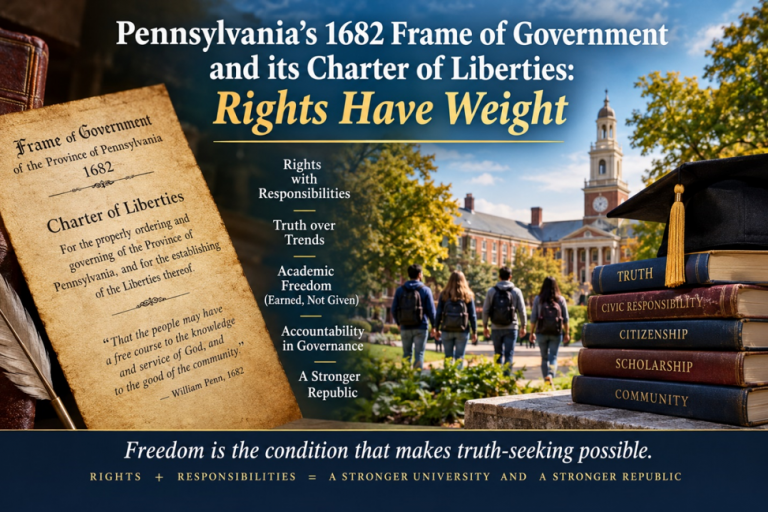
Fourth, the university must reclaim its role as a steward of intellectual freedom and moral seriousness. A free society depends on liberty of thought fused with free will. Universities should cultivate the habits of mind that make open inquiry possible, welcoming debate, tolerating friction, resisting both external domination and internal sameness. At their best, universities show institutional courage: defending academic freedom as the heart and soul of scholarship. This is not a partisan claim; it is a civic necessity. Rights must be discussed alongside responsibilities, and moral principles must be debated openly and civilly, or the institution drifts toward serving influence rather than truth.
Finally, higher education must remember that its highest service is to students first, not to bureaucracy, not to committees that reproduce themselves, not to political fashion and not to a credentialing economy that mistakes symbols for competence. The liberated learning “marketplace” should produce vitality and variety, but it must be anchored by standards, integrity and stewardship. If universities are faithful to purpose, teaching well, controlling costs, telling the truth about value, defending intellectual freedom and forming citizens capable of responsibility, then higher education will again earn public confidence. And that is the only durable way forward.
Walter V. Wendler is the President of West Texas A&M University. His weekly columns are available at https://walterwendler.com/.