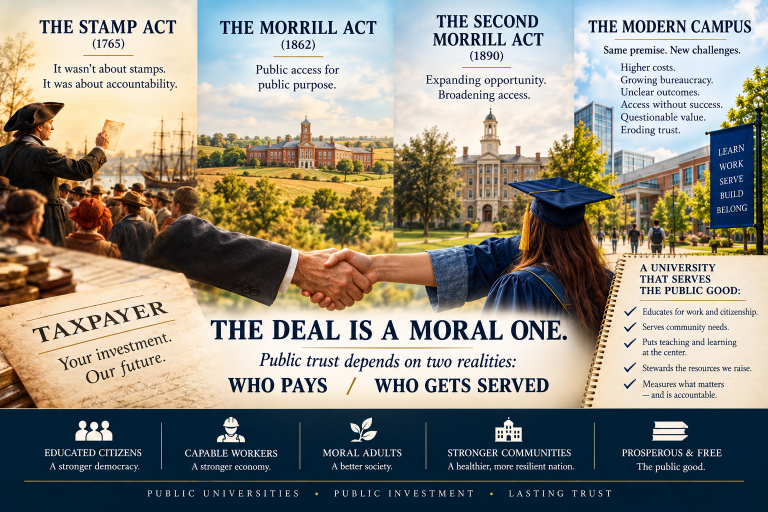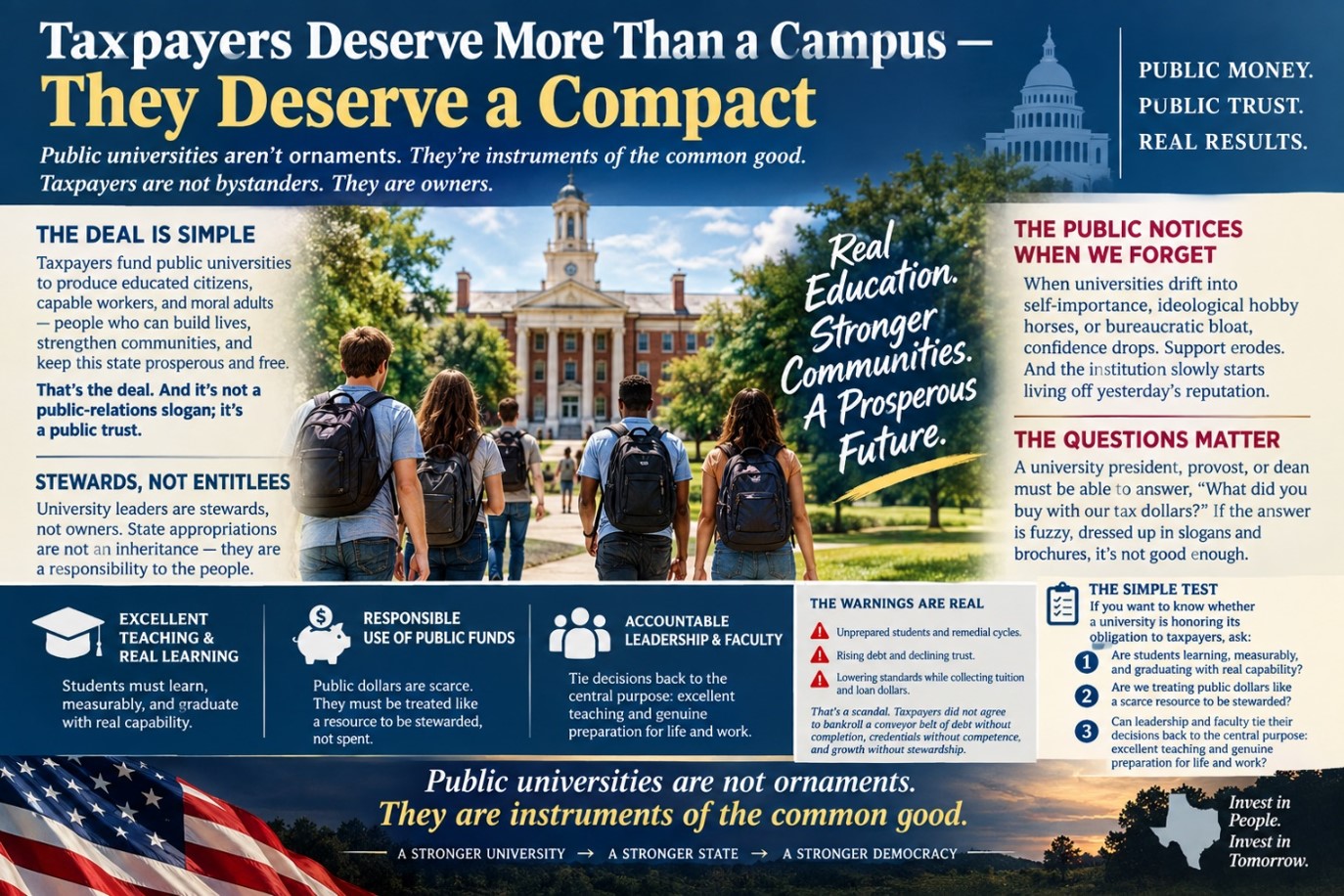
Taxpayers don’t fund a public university so it can admire itself. They fund it to produce educated citizens, capable workers, and moral adults, and people who can build lives, strengthen communities, and keep this state prosperous and free. That’s the deal. And it’s not a public-relations slogan; it’s a public trust.
As I’ve said on several occasions, our first responsibility as a state-supported institution is to the people of our state. Our work is sustained through tax revenue. We are in the taxpayer’s debt. That’s plain talk. That’s plain truth. When universities forget it, when they drift into self-importance, ideological hobby horses or bureaucratic bloat, the public notices. Confidence drops. Support erodes. And the institution slowly starts living off yesterday’s reputation. To quote Hank Williams Sr.’s perspective, “My Bucket’s Got a Hole in It.” University leadership needs to look through the gate, peer over the wall, and understand how, who, and why they serve. Plug the hole(s).
University leaders have no right to treat state appropriations as an inheritance or entitlement. University leaders are stewards. The American Council of Trustees and Alumni just last week, in response to Secretary of Education Linda McMahon’s call to action, emphasized the importance of accountability. Who could public higher education be more accountable to than taxpayers who foot a significant portion of the tab? Declining public funding isn’t an excuse to whine; it’s a warning to lead with clarity, discipline, and measurable purpose. Public money is scarce, and sloppiness in higher education effectiveness and efficiency…falls at the feet of leadership and benefits neither public nor student.
A president, provost, or dean must be able to answer one hard question from a citizen in Borger or Brownsville in my home state of Texas: What did you buy with our tax dollars? If the answer is fuzzy, if it’s dressed up in slogans, task forces, and glossy brochures, then the answer is probably not good enough. Committee meetings won’t address the issues; too many oxen get gored. Wisdom vanishes as moral authority hides in the shadows of feigned responsibility.
Nothing matters more to quality than faculty. But with that privilege comes a duty: teach well, govern responsibly, and police quality in your own guild. I’ve argued that academic quality is determined by faculty and faculty alone. Academic freedom is frittered away and sustained, in too many cases, through ideological tests, rather than scholarly excellence. Legislators can fund or frustrate, but they cannot make a professor prepare, inspire, mentor, or uphold standards. That is faculty work: daily, demanding, human work.
And here’s the punchline: if we cannot explain to any citizen why and how their taxes support the university, we are already losing the argument. Faculty scholarship matters, but it must never become an insulated exercise that forgets the people paying the bills and the students staking their futures on the degree.
One of the most corrosive betrayals in higher education is this: enrolling students who aren’t prepared, pushing them into remedial cycles they must finance, and then acting surprised when debt rises and trust collapses. I’ve called that what it is: a travesty carried out on the backs of students, often sustained by systems that make it easy to collect tuition and loan dollars while outcomes lag. And too often leadership and faculty survive the hardships with an absolute disregard for what taxpayers expect from higher education. It is a scandal: taking money while lowering standards.
Taxpayers did not agree to bankroll a conveyor belt of debt without completion, credentials without competence, and growth without stewardship.
There is a simple Test. If you want to know whether a university is honoring its obligation to taxpayers, ask three questions:
- Are students learning, measurably, and graduating with real capability?
- Are we treating public dollars like a scarce resource to be stewarded, not spent?
- Can leadership and faculty tie their decisions back to the central purpose: excellent teaching and genuine preparation for life and work?
Public universities are not ornaments. They are instruments of the common good. Taxpayers are not bystanders. They are owners. And leadership and faculty must pursue that aim every day as a noble purpose. It makes a constitutional republic better.
Walter V. Wendler, Professor of the Practice, Bush School of Government and Public Service, President Emeritus West Texas A&M University, and Chancellor Emeritus of Southern Illinois University Carbondale. His weekly columns, with hyperlinks, are available at https://walterwendler.com/.