Sixth in a series on Public Higher Education.
Frédéric Bastiat warned us plainly, that when the law is twisted from its proper purpose, society suffers a particular kind of moral injury. In The Law, he argued that the state exists to protect life, liberty and property, not to serve as a polished instrument for special advantage. He called it legal plunder when public power is used to benefit a few at the expense of the many.
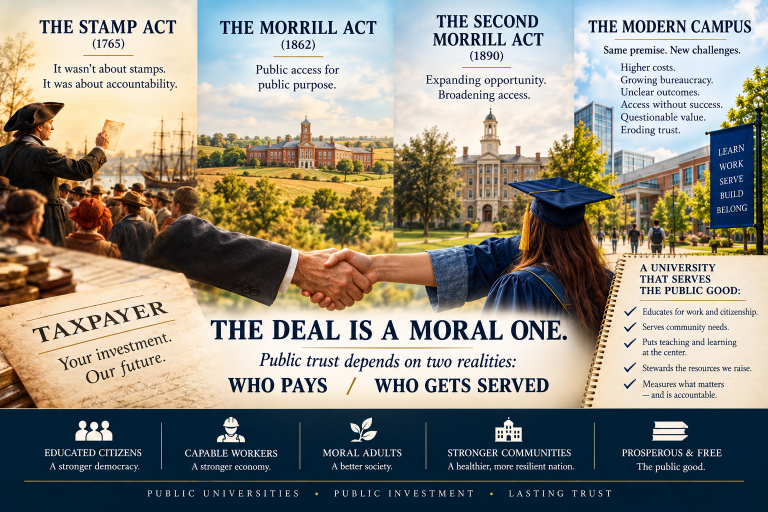
Now take that same moral lens and point it at modern public higher education. The results aren’t flattering. Public universities were built, by law, by tax support and by public sacrifice, to widen opportunity, not to curate an upper caste. This concept was enlivened by the Morrill Land Grant of 1862, and the Morrill Land Grant of 1890. And yet, across the nation, too many public institutions have drifted into a status economy: chasing rankings, selectivity and prestige signals that play well on glossy brochures but often work against the public purpose. Often, rankings reward the wrong virtues. National rankings, according to a recent publication in The Conversation, commonly favor high admissions rejection rates, high spending per student and high percentages of alumni giving. That recipe tempts institutions, especially public ones, to manage admissions “yield,” chase full-paying applicants and prize selectivity over service. The system may be “gamed.” That isn’t leadership. That’s marketing.
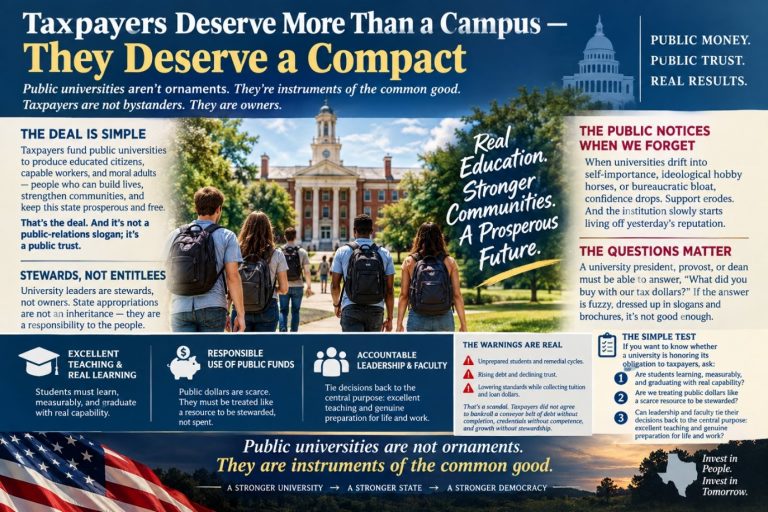
And the distortion is worse for public universities because they operate with the public’s money and under the public’s trust. When taxpayers fund an institution, they are not underwriting a social club. They’re investing in a civic engine, one meant to educate citizens, strengthen communities and build a capable workforce.
Bastiat might assert that the system creates incentives for institutions to serve reputation rather than citizens. Often with well-intended rationalizations. But the end result is the same: a public good is repurposed into a status good.
The most revealing test is not what we say, but what we reward. Some admissions filters amplify the value of advantage. Consider the common list: legacy and donor preferences, early decision, heavy reliance on standardized tests and recruitment patterns that oversample affluent schools. These are not merely “neutral tools.” They can become gates and fences, quietly separating the advantaged from those the institution exists to serve.
Then comes pricing and financial aid strategy, the part few universities want to explain in plain English. High sticker price, merit discounts for already-advantaged students, limited need-based aid… create gates and fences for those unable to participate. When merit aid is used less as a reward for achievement and more as a lever to raise averages and climb rankings, it becomes a kind of institutional vanity.
Bastiat’s framework applies again: if public institutions redirect benefits toward those already most able to pay, because it boosts prestige, then the public purpose has been hollowed out. That’s not upward mobility. That’s social sorting with a financial aid office. When public universities mimic elites, they become strangers at home. A public university that imitates elite private institutions may gain a momentary glow in the national mirror, but it risks losing something more valuable: belonging.
Many institutions lose touch with those served because they believe they know better than the public about what they want and need. Leaders should be stewards of the regions they serve. That stewardship is not sentimental. It’s practical. It is the difference between a university being a civic anchor and being an imported ideology or a status-seeking brand. When a campus starts acting like an exclusive club, it should not be surprised when the public starts treating it like one: with suspicion, resentment and eventually, disinvestment. Trust is hard-earned and quickly squandered.
And it’s not only admissions. It’s culture. It’s the hidden curriculum identified by Notre Dame: who feels welcome, who can afford unpaid internships, who can study abroad, who can network without needing a second job. You can call it student life; many families will call it a price tag disguised as tradition. Let’s correct a common misreading. Critiquing elitism is not the same as endorsing entitlement.
Everybody deserves a chance to perform. Everybody. However, and simultaneously, nobody deserves a guarantee. A public university should never become exclusive by design, but it also cannot survive, morally or academically, by pretending standards don’t matter. The university’s duty is to tell the truth about readiness, set honest expectations and build pathways that help students rise to the level of real performance. That’s service. It’s not sentiment. If the goal of public higher education is to serve the public, then the North Star isn’t selectivity, it’s value. That is not anti-intellectual. It is pro-student and pro-society.
A healthy public institution should be proud, not of who it keeps out, but of who it educates well: students who can write and speak clearly; graduates who can solve problems and think critically; citizens prepared for work, family life and civic responsibility; and people who can move, with dignity, into the middle class and beyond. This is the moral center of the public university.
Bastiat insisted that a just society refuses to use public instruments for private advantage. Public higher education must take that seriously. If it becomes a prestige machine, subsidized by citizens and optimized for status, it will fail the public trust test. And no strategic plan, no branding campaign, no new stadium and no vision statement will rescue it.
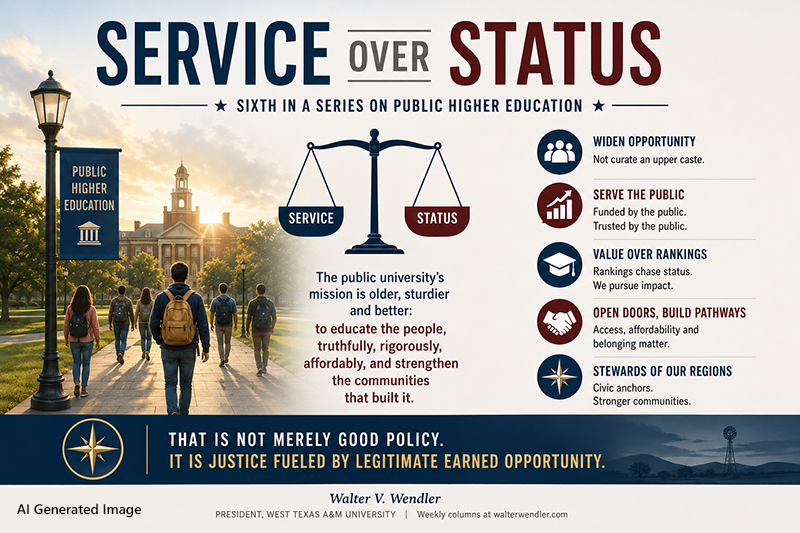
The remedy is not complicated, but it requires backbone: restore the idea of service over status. Let the rankings do what they will. The public university’s job is older, sturdier and better: to educate the people, truthfully, rigorously and affordably, and strengthen the communities that built it.
That is not merely good policy. It is justice fueled by legitimate earned opportunity.
Walter V. Wendler is the President of West Texas A&M University. His weekly columns are available at https://walterwendler.com/.