Third in a series on Public Higher Education.
America is tired of being sold. Families are tired of being told that tuition hikes are “unavoidable,” that fees are “modest” and that debt is simply the new rite of passage for adulthood. They are tired of paying more while experiencing, in too many places, higher cost with little change in the benefit. And when confidence wanes, university leaders too often respond with marketing campaigns, strategic plans and new slogans, as if distrust can be fixed with a better brochure. It can’t. Public trust isn’t manufactured; it’s earned. And in the cost/value/debt crisis, earning trust begins with one simple obligation: a public university must be able to look a family in the eye and defend its value proposition, truthfully, specifically and without sleight of hand.
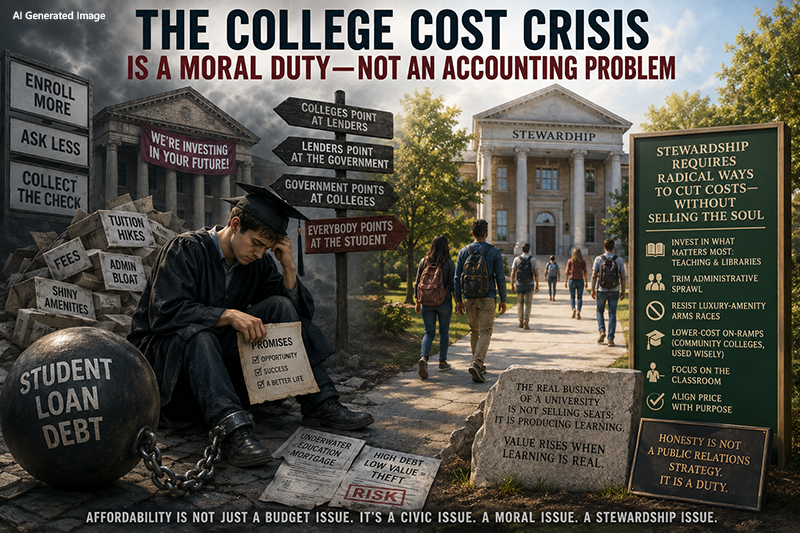
Debt isn’t an inconvenience. It’s a calamity. Samuel Johnson warned, “Do not accustom yourself to consider debt only as an inconvenience; you will find it a calamity.” That line belongs on the wall of every administrative office, every boardroom where tuition is set and every office where enrollment targets are discussed. Because what we’ve normalized in higher education isn’t merely borrowing, it is the systematic expansion of risk onto students while institutions and policymakers protect themselves with distance and plausible deniability. The Cicero Institute reports on degrees with negative return on investment where the university avoids any responsibility. All it takes is transparency. Colleges point at lenders. Lenders point at the government. The government points at colleges. Everybody points at the student and says, “You signed the papers.”
This evasiveness is not just inefficient; it is immoral. Universities systematically misrepresent the value of a degree. The idea that any degree, under any circumstances, has good value is not optimism. It’s a lie. And when that lie is paired with bankruptcy-proof loans and rising sticker prices, we end up with underwater education mortgages, millions of people burdened for decades, often without a credential strong enough to repay the debt it required. We should say out loud what polite society avoids: High debt with low value is theft. Not always theft of dollars in the criminal code sense, but theft of time, hope, agency and future freedom. And, according to Harvard, universities are some of the most change-resistant organizations in our nation.
The rotten incentive: enroll more, ask less, collect the check. The enrollment-at-all-costs model is tempting for public universities because it feels like a matter of survival. But it comes with some costs, as identified by The Vine Down. When state support shrinks and budgets tighten, some leaders decide the solution is simple: bring in more paying customers. But students aren’t customers in the way a retailer means it, and education isn’t a commodity you slide across a counter. When universities treat enrollment like retail traffic, predictable things happen: Academic standards get diluted because it is hard to maintain revenue and rigor simultaneously without courage. Students who are not prepared are allowed to linger, sometimes for years, because the loan money keeps flowing. Institutions begin to substitute financial tactics for educational integrity: accounting maneuvers, shiny amenities and administrative layering that expand cost without expanding learning.
“Prevarication, by omission or commission, is immoral, and fritters away the hard-won trust of the republic.” If a university knows a student’s odds of success are low and still ushers them in, smiling, signing and collecting, then we’re not talking about access anymore. We’re talking about exploitation dressed up as opportunity. And let’s be candid: even the NCAA sometimes requires more academic progress from athletes than universities require from the general student body. That should embarrass us into reform.
Frederic Bastiat, in The Law, reminded us that “Life, faculties, production, in other words, individuality, liberty, property, this is man…these three gifts from God precede all human legislation, and are superior to it.” Bastiat’s point is not antiquarian political philosophy. It’s a flashing warning light for modern higher education: when public systems are designed so that people can take resources without responsibility, when costs are obscured, consequences are externalized, and accountability avoided, the machinery of a free society starts to grind. Anything that diminishes personal responsibility in education tears at the fabric of a free society and our constitutional form of government. This is why affordability is not just a budget issue. It’s a civic issue. A moral issue. A stewardship issue.
Yes, education creates public benefits. But it is not an “inalienable right” in the way speech or worship is a right. It is an opportunity, an earned privilege, like a driver’s license or a home mortgage. Lending to those who cannot reasonably succeed or allowing continued borrowing when the chances of completion approach NIL is indefensible without a bright, unapologetic buyer-beware warning. Forbes looks carefully at the return on investment. The real business of a university is not selling seats; it is producing learning. It is cultivating disciplined thought, marketable capability, moral seriousness and civic maturity. If costs rise while instruction weakens, if tuition increases fund bloat more than brilliance, then the institution is not just inefficient. It is betraying its purpose.
Stewardship requires “radical ways” to cut the cost, without selling the soul. Affordability is stewardship. Stewardship means making hard choices, like a household making tough decisions: if libraries and teaching are foundational, invest in them. If something is tangential to purpose, stop doing it, no matter how politically painful.
Cost reduction that isn’t cosmetic: trimming administrative sprawl, resisting luxury-amenity arms races and refusing projects “tangential to educational purpose.” Lower-cost on-ramps, such as community colleges, can be used carefully, not mindlessly, so students can “road test” college without mortgaging their futures. A relentless focus on the classroom: engaged faculty, capable students, rigorous expectations. Because value rises when learning is real. The debt crisis will not be solved primarily by Washington announcements or clever repayment schemes. It will be solved when universities regain the courage to tell the truth and to align price with purpose.
The public is not asking for perfection. They are asking for honesty. And for public universities, honesty is not a public relations strategy. It is a duty.
Walter V. Wendler is the President of West Texas A&M University. His weekly columns, with hyperlinks, are available at https://walterwendler.com/.