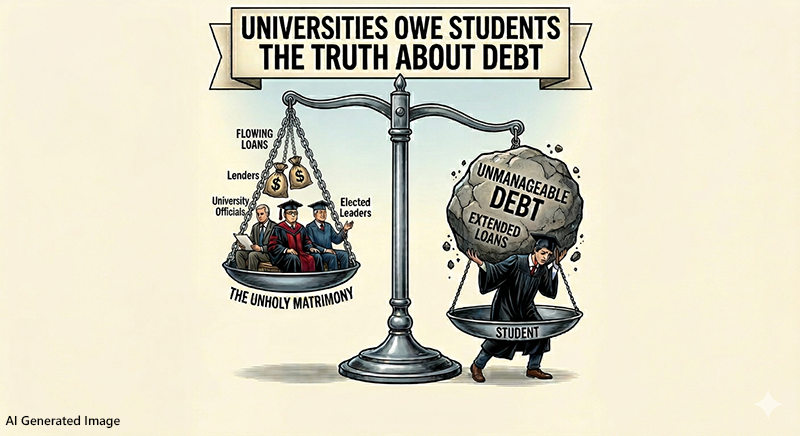
As high school graduation approaches, many students and families continue to consider college attendance and the costs and benefits. Forbes says too many borrow too much with too little thought. The plain truth is that universities have allowed uninformed borrowing, and universities must take responsibility. Nearly two out of three students pursuing a baccalaureate degree borrow money, according to The Urban Institute. For some students, at some institutions and in some majors, indebtedness works, reports University Business. For the rest, debt proves unmanageable while universities, lenders and elected officials hide in the shadows. Students are left holding the bag, says the Council on Foreign Relations.
I want to suggest five principles universities must confront if they intend to recover integrity and public trust.
First, debt is a moral issue, not just a financial one. I have written previously that “Absolution of personal responsibility in college borrowing undermines the value of higher education.” That applies to students and to institutions. When universities accept students who are unprepared for rigorous study and help them borrow money for degrees with little chance of earning enough income to repay the loans, the institutions share the blame. Over‑borrowing is not inevitable; it is allowed. Educational debt decisions are often fueled by youthful idealism, financial naiveté and misplaced faith in rosy projections. Too often, cautioning students about educational debt is seen as counter to the institution’s financial interest. Institutional morality is needed. At some point, universities should have the temerity to say: “You are borrowing too much and making too little academic progress. Go to work for a season, pay down your debt, then return.” That conversation rarely happens. The NCAA has an Academic Progress Report to ensure progress toward degree completion. Why not an Academic Financial Report for all students that shows how borrowing rates indicate meaningful progress toward degree completion and a long-term return on investment?
Second, access without standards is cruel. In the Higher Education Equal Opportunity Act of 1970, President Nixon declared that no qualified student should be barred from college because of poverty. That is a noble aspiration. But the ability to pay and the ability to perform are not the same. Withholding opportunity because of poverty is wrong. Restricting access when academic performance is weak is right. The ability to learn, not the ability to borrow, should drive the enterprise. A 2017 National Library of Medicine Study reveals that students who enter underprepared have dramatically lower success rates. Access does not automatically equal success. When universities admit students with slim chances of graduating and certify them as eligible borrowers, they create a false promise. Students borrowing extravagantly, untethered from performance, is not compassion. It is careless. It is cruel.
Third, the unholy matrimony must be named. Federally insured loans have created an unholy matrimony among lenders, universities and elected leaders, reducing risk for everyone but students. Bankers lend because the government guarantees repayment. Universities enroll because the loan dollars flow. Politicians promise access because it polls well. When things go wrong, students, often first-generation of modest means, become the illegitimate children of this treacherous triangle. Students borrow too much because over‑borrowing is condoned. When repayment forgiveness plans shield financial institutions from consequences, accountability wanes. When universities face no penalty for poor completion or repayment outcomes, moral hazard flourishes. Transparency trumps everything. Universities and lenders must disclose costs, likelihood of completion, repayment rates and employment prospects plainly lest public trust evaporates, which is happening.
Fourth, amenities over mission are institutional cowardice. The forces contributing to rising costs are not all under institutional control. Some universities borrow heavily for projects tangential to educational purposes, like football palaces, five-star dining and expansive recreation centers. The mine-is-bigger-than-yours model of excellence can be nothing more than fleeting luster. What is the mission? Who is served? What defines quality? What happens when demand evaporates? Purpose, efficiencies, projected revenues and expenses are not corporate intrusions into sacred university space. Unchecked borrowing is a lifelong burden. In many cases, students accumulate debt exceeding tuition, fees and living costs. If a banker would not lend $55,000 for a car worth $15,000, why would a banker routinely do so for higher education? If university leadership knows of lower-cost alternatives for students who must borrow and fails to tell a student, there is a moral lapse. Universities should advise students to attend a community college and transfer hours wisely, work and eat ramen noodles and hot dogs to save money, if necessary. Hard work and persistence are golden opportunities, not diseases.
Fifth, as reported in the New York Times, the gravest debt is the erosion of public trust. Prevarication, by omission or commission, fritters away hard-won trust in a republic. When universities systematically misrepresent the value of degrees, market low-utility programs as tickets to prosperity or behave corporately rather than as opportunity engines guided by principle, they sacrifice relevance. Relevance is the only insurance against failure. Education is never free; it requires intellectual, moral and financial work. When costs are detached from responsibility, the equation does not compute. If truth drives down enrollment, so be it.
Universities must recover the courage to align access with preparation, borrowing with realistic outcomes and performance with costs. Universities would do well to counsel with candor; anything less is an abdication of duty. Higher education, at its best, was never meant to be a conveyor belt of federally financed aspiration. Higher education exists to cultivate disciplined minds, capable citizens and durable opportunity. We owe students and families the truth and the greater public nothing less.
Walter V. Wendler is the President of West Texas A&M University. His weekly columns, with hyperlinks, are available at https://walterwendler.com/.