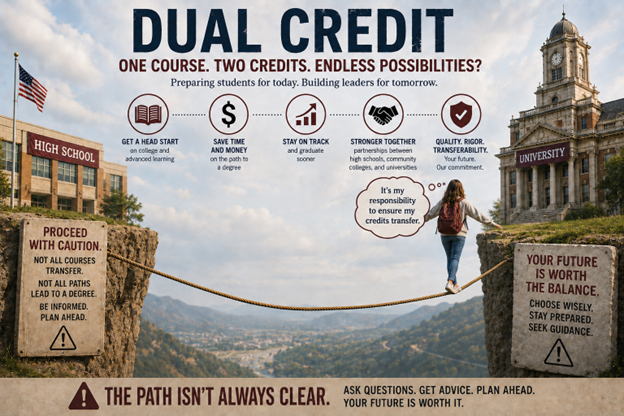
Dual credit, taking college courses while still in high school to count toward high school and college graduation, can be good for universities and students, but only when courses are rigorous, transferable and matched to a student’s readiness. Originally, dual credit was intended for advanced high school students to get an early start on college and advanced academics; it has since become a means of lowering the cost of a college degree. A 2006 brief from the Office of Community College Research and Leadership provides a thorough history. If done well, dual credit reduces costs without sacrificing quality, efficiently moves students toward a degree, and serves families and taxpayers. Several caveats are worth considering.
Quality must be real. Dual-credit courses cannot become high school courses with bells and whistles. Universities should insist on serious intellectual standards and qualified instruction. A problem arises when students take dual-credit classes and assume the course will count toward their preferred degree requirement. The course may transfer, but fulfill the intended purpose. The Texas Association of Community Colleges reports that multiplied millions of dollars are spent annually on dual credits that don’t transfer toward the degree plan. A disappointment for students, families and taxpayers.
College readiness isn’t automatic. Some students aren’t ready academically or emotionally for college-level expectations. The College Board confirms a direct relationship between genuine readiness and degree completion. Ill-prepared students provide short-term relief to enrollment challenges but are left holding a bag full of debt with little to show for it. Dual credit should not be sold as a one-size-fits-all shortcut or a savings opportunity, nor should universities resist it. A university’s job is to educate while protecting public trust and ensuring that dual credit is credible and intended for transfer.
A high school teacher and a university professor are both teachers. However, their roles are tailored to different aspects of a student’s development. High school teachers guide adolescents across the borders of school and life into adulthood. Strong high school teachers work within a highly prescribed system of curriculum requirements, daily attendance structures and tighter supervision designed to support teaching and student development, with few expectations for publishing or generating knowledge in their fields of study. University professors, on the other hand, design courses to transform intellectual knowledge into professional application by learning to think like an engineer, nurse, teacher, historian or entrepreneur. I attended Texas A&M University to learn to think like an architect. The professor-student experience requires a bond of trust and commitment to the whole student (including engaged citizenship and responsibility). In addition to classroom instruction, professors are expected to contribute to their field of study through scholarship and creative work to enhance the quality of teaching. Professors advise, mentor and guide both the individual and the institution into a productive framework through preparation for vocational leadership in the community. Included in the basic job expectations of professors are assessing student learning, holding office hours, advising students, serving on committees and producing regular scholarly output. The difference between a high school teacher and a university professor shows up in accountability for “college-level” rigor and outcomes.
Credentials and qualifications. For many dual-credit arrangements, the instructor in the high school must meet the college faculty’s credential expectations (often a master’s degree in the field or closely related). The Greater Texas Foundation reports that rural districts often struggle to attract teachers with the required dual credit teaching credentials. When qualifications are missing, quality can slide. Without proper standards, dual credit can become little more than a high school course that counts toward a college degree.
Dual credit standards and transfer toward a degree get dicey. Even if a dual-credit course is taught well, a potential problem remains: will the course apply toward the intended degree? Not always, according to the Community College Research Center at Columbia University. For example, a student hoping to become an engineer may take dual-credit algebra, earn high school and college credit for the course, only to discover that engineering programs require calculus toward degree completion. The algebra course doesn’t apply toward engineering requirements. That’s a stewardship problem. That’s a dual credit problem. That’s a community college and university problem. Student enrollment headcount often comes through shedding responsibility.
Dual credit is most often delivered through community colleges, and it works best when those colleges partner with universities to protect students’ best interests through quality and transferability toward the student’s desired degree. The real solution is relentless, transparent student advising and thoughtful articulation agreements between community colleges and universities. Community colleges were born, in part, to help students become ready for university work, according to the Joliet Junior College website: “America’s first public community college began in 1901 as an experimental postgraduate high school program. It was the ‘brainchild’ of J. Stanley Brown, Superintendent of Joliet Township High School, and William Rainey Harper, President of the University of Chicago. The college’s initial enrollment was six students. Today, JJC serves more than 30,000 students in credit classes and noncredit courses.”
Universities must stay engaged in dual credit to ensure rigor and trust. According to the RTI Press, universities must be able to trust that dual-credit courses are truly college-level work and help students save on costs by reducing the time to a degree. Community colleges should offer dual credit because it aligns with their access-and-preparation mission. Universities should not resist dual credit transfer out of fear of losing market share. Over 50% of WT’s transfer students come from four community colleges. WT’s local partnerships create an environment that helps to ensure quality, degree applicability and smooth student transition.
The goal of WT is to hire or approve all faculty who teach, whether in dual credit or PUP (Pre-University Programs) courses. We recognize that the fiscal constraints of such a commitment and the effect of limiting the number of offerings. We believe the tradeoff is in the best interests of all involved.
Walter V. Wendler is the President of West Texas A&M University. His weekly columns are available at https://walterwendler.com/.