For more than half a century, public universities have drifted toward a quiet fiction: that intellectual seriousness requires separating spiritual conviction from academic inquiry. No policy announces it. No president endorses it. No faculty group would condone it. Yet, the practice is visible. Students are encouraged to bring their identities, cultures and political perspectives into the classroom. But when it comes to faith, they are often told, explicitly or implicitly, to leave it outside. This is not neutrality. It is fragmentation.
The university’s central purpose is the formation of whole persons, mind, character and spirit. We do not think in compartments. Moral commitments shape the questions we ask, the evidence we consider persuasive and the conclusions we are willing to draw. To pretend that reason floats free from a worldview is not sophistication. It is a denial of the human condition. Faith and reason constitute a historic partnership. The modern university was born from the marriage of faith and reason. Harvard, Yale and Princeton were founded to cultivate both intellect and virtue. Medieval universities debated theology and physics in the same breath. Augustine and Aquinas welcomed objections before answering them. Disagreement was discipline, not crisis.
The notion that science and ethics must be separated is a relatively modern development. In the 19th century, some institutions began distancing themselves from faith out of fear that moral conviction would weaken scientific standing. What began as prudence evolved into paralysis. Public universities must not endorse one faith over another, to be sure. That constitutional boundary is essential. But institutional restraint does not require intellectual abstinence. Compartmentalizing reason and faith into hermetic courses does not support integrated study. People do not become moral by studying comparative ethics. They become moral by living within a moral framework. Amoral worlds lack substance.
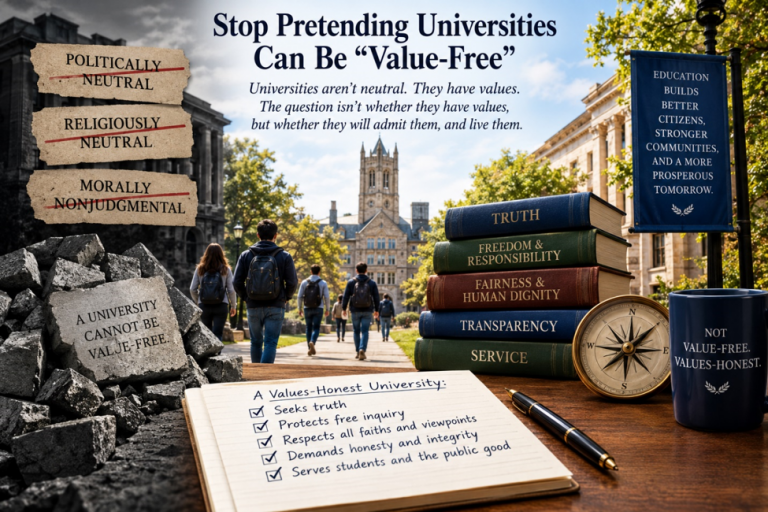
The vacuum of meaning is not an accident. Postmodern suspicion of grand narratives has led many campuses to purge themselves of any structured moral framework, especially a religious one. The assumption is that this produces objectivity. It does not. No one reasons from nowhere. When moral frameworks are removed, a vacuum forms and vacuums do not remain empty. They are filled by ideology, fashion or political orthodoxy. David Brooks observed that universities are more glittering than ever, yet something feels empty. Students learn how to do things but are rarely pressed to ask why. A university without moral inquiry becomes efficient, possibly, technically proficient, maybe, and too often, hollow. If higher education is to retain public trust, it must recommit to truth as objective and discoverable. Without shared standards of inquiry grounded in moral seriousness, scholarship devolves into performance and power play.
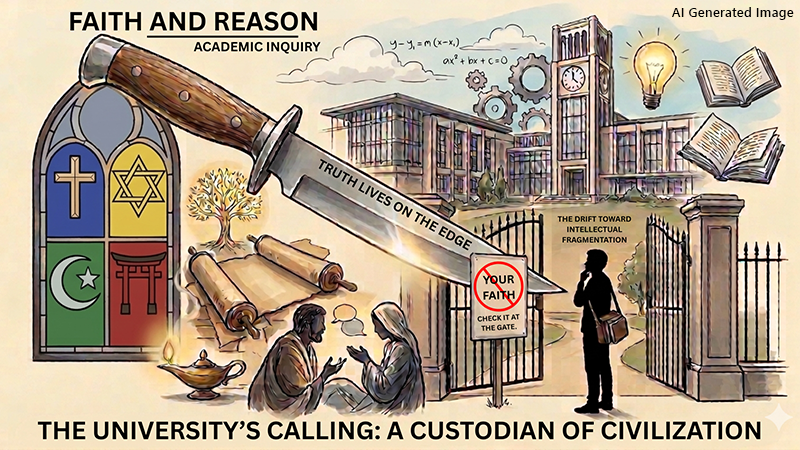
Tolerance and conviction are the knife’s edges. The sides of a knife do not cut; the sharpened edge does. Truth lives on that edge, between faith and reason. Tolerance without conviction is meaningless. Conviction without tolerance is tyranny. Universities should be the safest place in society for deep disagreement conducted with humility and rigor. The Judeo-Christian tradition models, “argument for the sake of heaven,” debate not to conquer but to approach truth together. Across the Talmud, rabbis dispute with reverence. Paul reasoned in marketplaces. Aquinas welcomed objections before answering them. Ideas offend people, and every idea is divisive. That is not a defect of the university; it is evidence that ideas matter. When students fear social retribution, they fall silent. When faculty fear professional consequences, inquiry narrows. When administrators fear headlines, truth becomes negotiable. And when truth becomes negotiable, academic freedom erodes quietly. That erosion diminishes institutional legitimacy and public trust.
Whole persons culminate in civic purpose. The assumption that students are uninterested in spiritual life is empirically false. Students arrive on campus with convictions. The university can engage those convictions or ignore them. Ignoring them does not make them disappear. It drives them underground. A republic cannot endure without moral formation. Liberty without virtue collapses into license. Education must cultivate not only knowledge, but judgment, humility and courage. Human beings reason from conviction. The question is not whether faith belongs on campus. The question is whether a university can fulfill its mission while pretending that faith does not shape thought.
Reintroducing moral seriousness into higher education does not mean establishing religion. It means: Encouraging reasoned engagement across religious and secular perspectives; protecting freedom of conscience as foundational to academic freedom; integrating ethical reflection into professional preparation and teaching students not only how to make a living, but how to live. A university that reduces itself to technical training betrays its calling. It becomes a credentialing center rather than a custodian of civilization. If we want courageous thinkers, we must allow courageous conversations.
If we want intellectual sharpness, we must sharpen both sides of the knife, faith and reason. Truth lives on the edge. And a 21st-century university worthy of public trust must have the courage to stand there.
Walter V. Wendler is President of West Texas A&M University. His weekly columns are available at https://walterwendler.com.