Public, and I Mean Public, Higher Education: A Values-Driven Case for Mission, Trust and Renewal
First in a series on Public Higher Education
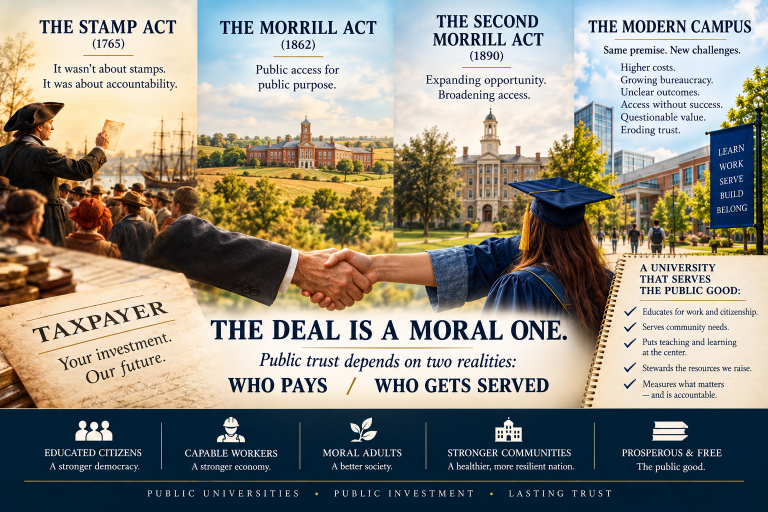
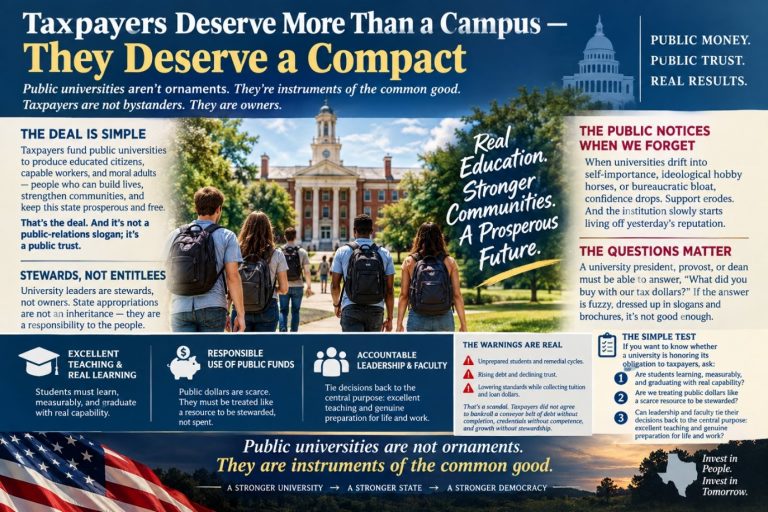
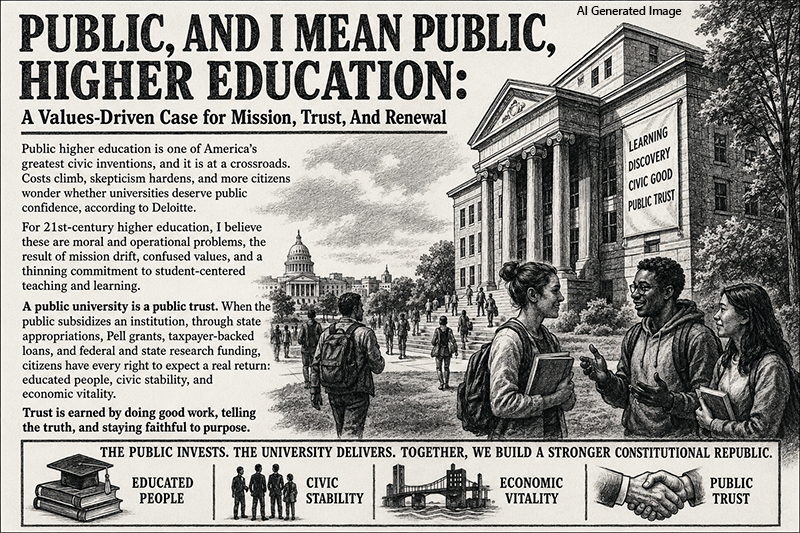
Public higher education is one of America’s greatest civic inventions, and it is at a crossroads. Costs climb, skepticism hardens and more citizens wonder whether universities deserve public confidence, according to Deloitte. For 21st-century higher education, I believe these are moral and operational problems of mission drift, confused values and a thinning commitment to student-centered teaching and learning. A public university is a public trust. When the public subsidizes an institution, through state appropriations, Pell grants, taxpayer-backed loans and federal and state research funding, citizens have every right to expect a real return: educated people, civic stability and economic vitality. Trust is earned by doing good work, telling the truth and staying faithful to purpose.
Mission and public trust must be re-centered and earned. Substituting marketing for mission hollows out universities. Higher education too often speaks defensively and ineffectively rather than plainly explaining what it does, why it matters, what it costs and what it produces. Forbes reports that when trust erodes, legislative support, philanthropic confidence, enrollment stability, and the social authority needed to maintain standards follow suit. If universities want confidence, they must demonstrate institutional courage, clarity of mission, coherence between words and spending, and accountability for results. When the degree is commoditized and sold as a “golden ticket,” students can end up holding debt and disappointment, promissory paper of dubious value, with very concrete loan payments chasing them.
The cost/value/debt crisis is a duty, not an inconvenience. A public university must look a family in the eye and defend the cost/value proposition. Rising costs with little perceived increase in benefit is a recipe for public anger, and rightly so. Prevarication about costs and benefits is immoral, whether by omission or commission, frittering away the hard-won public trust. Too many institutions have chased enrollment dollars, grown bureaucracy, diluted standards, or run the university like a retail enterprise. Instead, universities are organizations that must be run with discipline. A businesslike approach, as I wrote in 2014, should strengthen the mission, not replace it. If a university wants to serve the underserved and keep costs low, it must change. That means asking: What business are we in? Who are we serving? What defines quality? And it means resisting the gratuitous “law of more” – more buildings, more amenities, more borrowed money – when those expenditures do not advance learning.
Public higher education has a civic purpose: to prepare not only workers, but citizens capable of participating in a free society and sustaining a constitutional republic. That requires fundamental communication, numeracy, history and government, science and disciplined reasoning. Students deserve breadth and intellectual diversity. Artificially narrowing education for internal financial advantage is a betrayal of students and the university. A regional public university serves large numbers of first-generation students, transfers, working adults, veterans and students balancing family responsibilities. These students are not served by the academic indulgence of faculty preference. They are served by a coherent, demanding education: one that builds usable capabilities to address the deeper human question. “How then should we live?”
Teaching is the first obligation, and the human touch is irreplaceable. Teaching cannot be treated as secondary to bureaucracy, image management or “ancillary services.” Digital tools and new technologies are powerful, but digital interaction alone will not be a satisfying substitute for an engaged environment tended to by a passionate teacher and a student. Much of what ails higher education cannot be fixed by slogans or new administrative layers. The heart of improvement is profoundly simple: a concerned teacher working directly with a motivated student. That “human touch” is not sentimental. It is the core mechanism of learning, persistence and personal formation. Public universities serve complex student populations; they need faculty and advisors who refuse to coddle students but also refuse to abandon them.
Public higher education must resist elitism and reclaim service over status. Public higher education is not meant to be exclusive. There is no moral room for exclusivity as an end, only room for performance. Ranking systems and prestige incentives often reward selectivity and status signaling, and that can distort a public institution’s behavior. When public universities mimic elite private institutions, they become strangers to the very communities that created them. A healthier aim is social mobility grounded in genuine capability: writing, reasoning, problem-solving, technical competence and intellectual seriousness. A public institution should be proud not of who it keeps out, but of who it educates well.
The public university is tied to place, prosperity and the common good. Regional universities are intertwined with their communities. Whitehead’s admonition belongs here: “Unapplied knowledge is knowledge shorn of its meaning… A university… must mate itself with action.” When we put knowledge to work locally, we improve the community and region, strengthening the university. Real needs provide the best “grist for our mill.” Private benefit and public good are welded together and justify public support. University graduates earn more over a lifetime, and the region also gains workforce capacity, civic stability and problem-solving strength. When universities honor this agreement with integrity, focus and disciplined stewardship, public confidence follows.
In a moment when Americans are unsure what to believe about colleges, the way forward is better stewardship: clear purpose, strong teaching, sound standards, affordability and fidelity to public aspiration and public good.
Walter V. Wendler’s weekly columns: https://walterwendler.com