West Texas A&M University in Canyon, Texas, a community of roughly 16,000 souls, is about 17 miles from Amarillo, with a population of roughly 200,000. Within 150 miles of campus, the per‑capita income is about $29,000. Because the place WT serves is a rural, hard‑working, lower‑income region, we do not have the luxury of getting higher education wrong. Public trust depends on delivering value plainly, consistently and measurably.
Therefore, the success of WT’s One West comprehensive fundraising campaign deserves attention beyond the historic amount raised. Fundraising campaigns are about more than dollars. Campaigns should make the institution better in measurable ways: more people should know the university’s value; engagement should widen and the communities served should benefit. A comprehensive campaign, done right, becomes a public statement of mission clarity and integrity. And in a region where honesty and trustworthiness are of profound and significant value, philanthropic success is not purchased through marketing; it is earned through alignment with local values, priorities and service to real people.
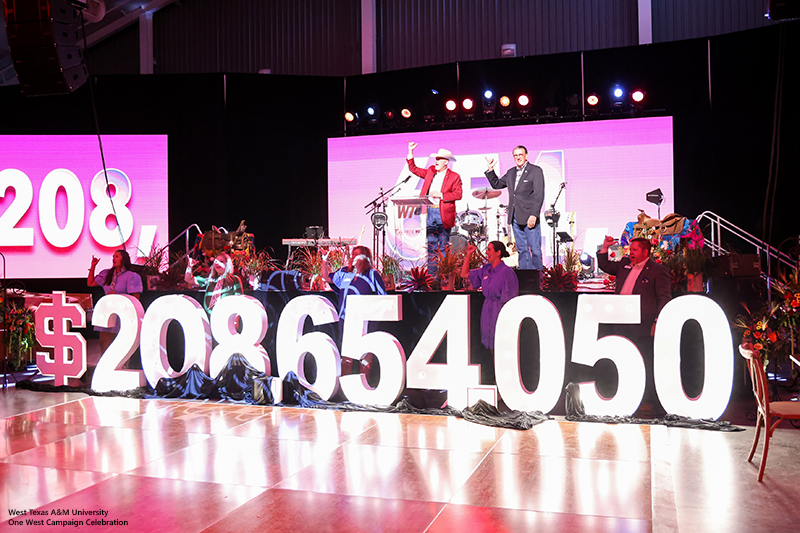
WT launched the One West campaign with a public goal of raising $125 million and reached that goal two years ahead of schedule. A new goal of $175 million was announced. At the close of the campaign, December 31, 2025, donors had given nearly $209 million. The success of the campaign is not merely a financial achievement; it is evidence that donors and partners trust WT to steward this place well and to lift this region by lifting its people.
Geographic and income comparisons of WT with other regional institutions show that many are closer to wealth, population and metro advantages. WT is not. And yet, in the Texas Panhandle, WT’s campaign traction signals something powerful: mission clarity travels farther than geography. When a university is transparent about its purpose, accountable for outcomes and unwavering about serving its region first, philanthropy follows as a shared investment in the common good.
A public university that accepts tax dollars is indebted to taxpayers, especially those taxpayers in the university’s service region. When universities, public or private (which both receive tax dollars), depart from commitment to place, they drift into “Harvard envy” and public confidence wanes. WT’s commitment to Panhandle values, Texas values and serving the Panhandle first is put into practice through locally valuable initiatives.
Affordability is a moral obligation. Cost and value are now central to higher education’s legitimacy. I have advised students and families to study carefully all costs of attendance. They should consider lower-cost, highest-value pathways, including community college. This is what Texans expect: candid, practical, family-centered stewardship.
Regional research can have practical outcomes. WT is a regional research university with research focused on regional needs like water scarcity, agriculture, rural healthcare, smaller school districts and rural community vitality. Such research is not boutique academic scholarship; it is problem-solving capacity aimed at Texas communities that carry a large geographic burden. Educational quality is determined by leaders, faculty and staff because at the best institutions they treat students with respect and dignity, “fearfully and wonderfully made,” not secondary to any other purpose or aspiration.
Citizenship and responsibility are core outcomes. Texas needs graduates who work, yes, but who also understand that citizenship, responsibility and risk-taking are part of the American dream and the Texas experience. Graduating and succeeding are guiding aspirations. Regional universities are positioned to build those traits because they are close to their communities and accountable to them. WT seeks squeaky-clean accountability and pragmatic approaches that produce results measured by real regional responsiveness. The One West campaign is a shining example of how public trust leads to philanthropic investments.
Texas cannot be world-class with only flagship and metro educational institutions. Regional universities are the workhorses of educational access, workforce development and community stability. WT is built to be a catalyst, not just a campus, and WT earns public trust the hard way: through service, results and stewardship.
Campaign “success” isn’t just about dollars; it’s about institutional improvement and earned public trust. Recent higher education campaigns have been studied, looking at enrollment, per capita income and fundraising totals. WT’s One West campaign performance sits in a very strong place related to donor confidence in mission, regional distinctiveness and impact. WT’s fundraising finish stands out. The following statistical details are brushstrokes on a painting of WT’s fundraising success.
West Texas A&M University (Canyon, TX): The “One West” campaign supporting the university’s “WT 125” long-range plan officially concluded on April 16, 2026, raising a record $208.6 million, with an enrollment of 9,257 students, resulting in $22,534 raised per student. University of Evansville (Evansville, IN): The “FORWARD” campaign surpassed its goal on February 27, 2026, totaling $130.4 million, 1,742 students/$74,856 per student. Major impacts include $20 million dedicated to scholarships and funding for new athletic facilities. Cedarville University (Cedarville, OH): Completed its “One Thousand Days Transformed” campaign on October 3, 2025, raising $205.8 million, 6,384 students/$32,236 per student. Davenport University (Grand Rapids, MI): Announced the completion of its “ELEVATE” campaign on September 29, 2025, raising $35.4 million, 7,232 students/$4,894 per student. University of Texas at San Antonio (UTSA): The “Be Bold” campaign officially closed its books on August 31, 2025, having surpassed its $500 million goal two years early, with 38,200 students and $13,089/student. The data comes from university websites.
Within a 200-mile radius of each campaign university, it is worth noting that WT raised $133/capita, one of 7 universities in the region: Evansville, $7/capita, one of 50 universities in the region, Cedarville, $8/capita, one of over 50 universities in the region, Davenport, $1/capita, one of 30 universities in the region, and UTSA, $31/capita, one of 100 universities in the region. Population distributions were obtained from StatsAmerica. As a fleeting thought, if UTSA served a region that provided it with philanthropy the way the Panhandle did in support of WT, UTSA would have raised a whopping $2,004,796,750.
While the Texas Panhandle is sparse in population, it is exceedingly generous in support of THE Panhandle’s university, and for that we are grateful.
Bottom line: WT didn’t just raise money, it strengthened belief.
Walter V. Wendler is President of West Texas A&M University. His weekly columns are available at https://walterwendler.com.