Adopted from May 2026 Commencement Speech.
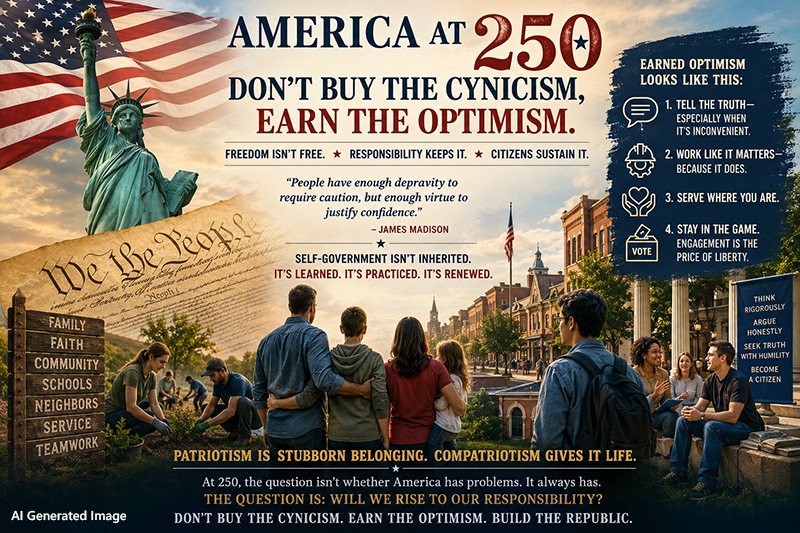
America turns 250 this year. That should mean celebration. But if all we do is throw fireworks and post flag photos, we’ll miss the point. Two hundred and fifty years doesn’t prove we’re perfect. It proves something more useful: we can endure. We can correct course. We can renew. But only when citizens decide—again and again—that freedom is not a spectator sport.
And that brings us to the unfashionable word we’d rather dodge: responsibility.
Right now, pessimism sells. The 24-hour news circuitry runs day and night, and it has a business model: keep people irritated, afraid and convinced the whole thing is breaking beyond repair. It tells us institutions are evil, trust is naïve and cynicism is sophistication. But cynicism doesn’t fix a school. It doesn’t strengthen a neighborhood. It doesn’t improve a university. And it sure doesn’t sustain a constitutional republic.
So, here’s my argument for America at 250: choose optimism—but earn it.
Not “everything will be fine” optimism. Not the kind of optimism that ignores hard facts. I mean the type of optimism rooted in moral seriousness: the decision to contribute more than you complain, to serve more than you perform, to build more than you bash. That kind of optimism is not soft. It’s steel. Freedom isn’t free—and it isn’t stable without responsibility. We like the language of rights. We’re less excited about duties. But you cannot have a functioning republic with a population trained to demand and untrained to shoulder.
Freedom and the personal responsibility required for the effective functioning of a republican form of government are powerful one-two punches. When leadership—or culture—encourages freedom to be uncoupled from responsibility, anarchy reigns and tyranny has room to grow. That’s not a partisan talking point. That’s basic civic mechanics. James Madison put it bluntly: people have enough depravity to require caution, but enough virtue to justify confidence. “There is a degree of depravity in mankind… so there are other qualities in human nature which justify a certain portion of esteem and confidence.” A serious country prepares for both truths. An unserious country pretends that one cancels the other.
Self-government isn’t inherited like eye color. It’s learned. One of the biggest lies floating around modern life is that citizenship is automatic. It’s not. It’s formed. As I’ve argued, knowledge and appreciation of citizenship and patriotism are not inherited. They must be taught, renewed and practiced. This is precisely why civic education matters—on campuses, in communities, in families and in everyday life.
If you want to know whether a republic will make it, don’t start by staring at Washington. Start by asking simpler questions: Do people show up for school board meetings? Do they volunteer? Do they vote with some knowledge, not just anger? Do they know their neighbors? Do they keep their word when it costs them something? That’s where self-government either lives, or dies.
Patriotism doesn’t mean blind agreement: it means stubborn belonging. Some corners of our culture treat patriotism like a dirty word. That’s a mistake—and it’s also a luxury belief. You don’t keep a free society by teaching people to despise the very idea of shared identity. Healthy patriotism is not the same as propaganda. It’s not forced uniformity. It is, at its best, a form of loyalty to the shared project—and a willingness to improve it without burning it down.
I’ve used another word alongside patriotism: compatriotism, belonging to smaller communities and groups that give life texture and responsibility: clubs, churches, neighborhoods, regions, teams and volunteer organizations. A cascade of those commitments helps hold society together. A free society cannot survive individual isolation plus online outrage. We need real community again—places where we learn to disagree without dissolving and debate without dehumanizing. And universities should help, not hurt.
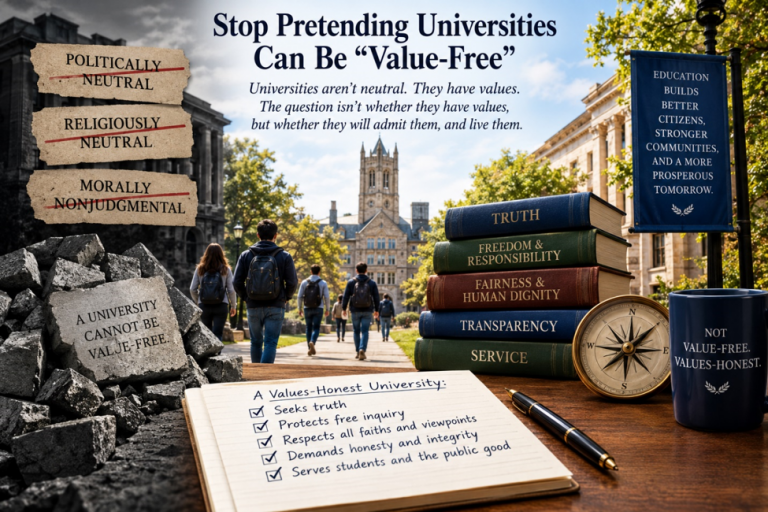
Universities: stop producing critics and start producing citizens. One of the big failures of modern institutional life, including higher education, is confusing critical thinking with raw criticism. I’ve said it plainly: “Critical thinking is essential… But critical thinking is, too often, described as raw criticism. The two ideas are not bound together in any meaningful way.”
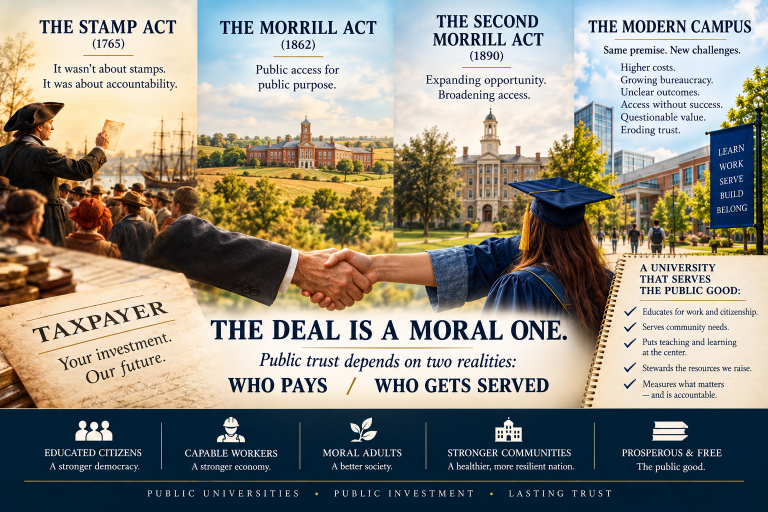
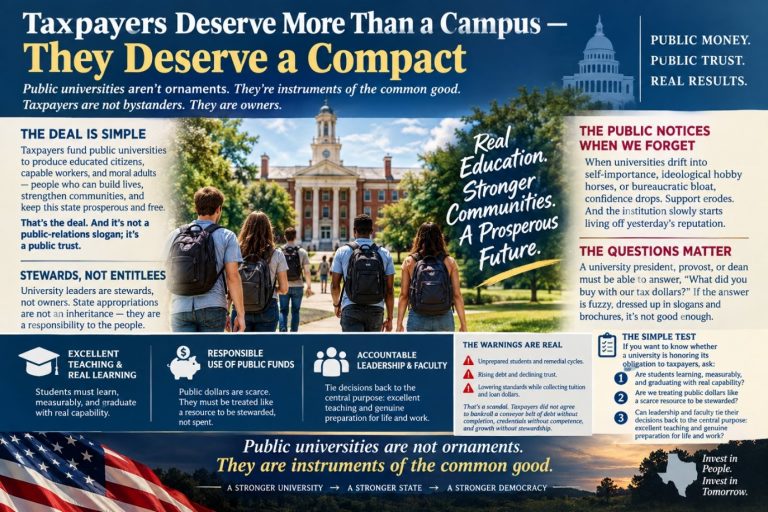
A university should be a place where students learn to think rigorously, argue honestly, weigh evidence and pursue truth with humility. That kind of education strengthens the public square. But universities also have to earn trust. They don’t get to demand public confidence while acting unaccountably. Thomas Paine’s warning still stings: “A body of men holding themselves accountable to nobody ought not to be trusted by anybody.” Public trust is fragile. And once broken, it’s hard to rebuild.
America doesn’t need more commentary. Our nation needs more contributions.
So, what does “earned optimism” look like at 250? Try these on for size:
- Tell the truth—especially when it’s inconvenient.
Our civic life is drowning in spin. Truthfulness is not a private virtue anymore; it’s a public necessity. - Work like it matters—because it does.
Work forms competence and character. A society that treats effort as optional and outcomes as guaranteed will eventually run out of both prosperity and purpose. - Serve where you are.
Civic renewal isn’t a national program. It’s a local habit. - Stay in the game.
Don’t live as a spectator. Don’t outsource citizenship to activists, pundits or politicians. Engagement is the price of liberty.
Civic engagement is fundamental to constitutional republics and is a driver of personal and community growth. In plain terms, societies get the citizens they cultivate.
At 250, the question isn’t whether America has problems. It always has. The question is whether we still have the resolve to renew what is good, correct what is wrong and defend what is worth defending, without collapsing into fashionable despair.
So yes, choose optimism. But don’t wear it like a slogan. Earn it. Earn it by living like a responsible citizen in a free country.
Walter V. Wendler is the President of West Texas A&M University. His weekly columns are available at https://walterwendler.com/.