Fourth in a series on Public Higher Education.
Public higher education has a civic purpose. That statement shouldn’t be controversial—but in 2026, it’s treated like an opinion. It isn’t. A public university exists because the public believes it serves the common good: preparing people for work, yes, but also for citizenship. Membership in a constitutional republic that can endure fruitfully when citizens can read carefully, reason honestly, speak clearly and judge fairly.
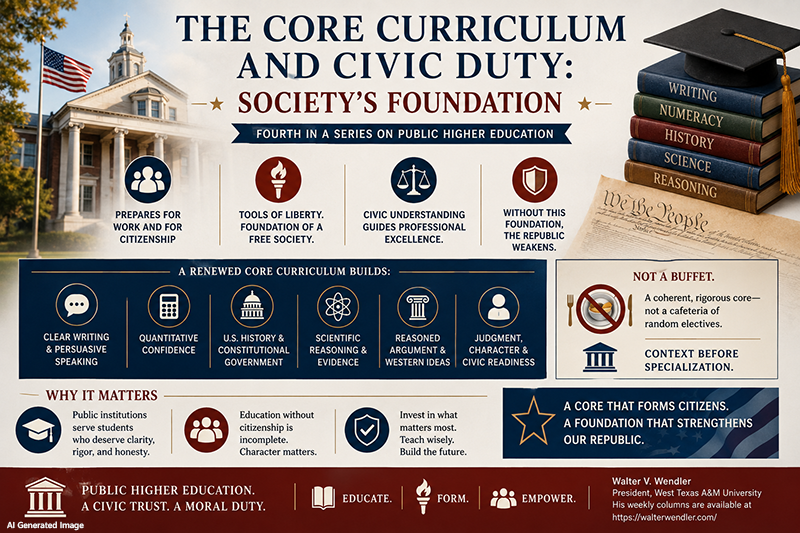
Educational leaders of every stripe must defend the core curriculum at every university in response to the people served, region-by-region. It propagates educated citizenship. The fundamentals, writing, numeracy, history, science and disciplined reasoning, are not nostalgic ornaments. These are the tools of liberty, the foundation of a free society and the embryonic spark of disciplinary excellence. Without this footing, we don’t graduate free people; we graduate dependents. And when that happens at scale, the Republic weakens from the inside out.
Frédéric Bastiat’s The Law matters. Bastiat warned that when law is distorted from its proper role, protecting life, liberty and property, into an instrument that takes from some to give to others, it becomes what he famously called Legal Plunder, as described by Dean Russell writing in the Foundation for Economic Education. Translate that principle into the university world, and the danger presents itself plainly: when the core curriculum is captured by internal politics, ideological fashion, or faculty-interest shopping, the institution quietly begins to take students’ time and tuition and give them what, exactly? A credential without capability. A transcript without formation. That is not merely inefficient. It is morally suspect. Lynne Chaney, then Chairman of the National Endowment for the Humanities, wrote clearly about the need for a rational Core Curriculum in Imprimis, a publication of Hillsdale College.
The core curriculum is not pre-major paperwork. One of the most corrosive lies on campuses is the notion that general education is what students must get out of the way before they really begin to study, as reported by Alexandra Armas in The Santa Clara. General education, properly conceived and executed with vibrant faculty, is the nucleus of being an educated human being. It is where students encounter the survey of the human condition, learn how to think across complexity and develop the habits required for self-government.
And yes, employers care. We can talk about the marketplace without selling our souls to the devil. The Association of American Colleges and Universities reports that employers overwhelmingly seek effective written and oral communication—eighty-nine percent naming it a top concern. Communication is not a soft skill; it is a hard requirement of competence. The ability to persuade, to explain, to interpret data, to write a coherent argument, these are not luxuries. They are employability.
To educate a person for work without educating them for citizenship is robbery, a form of plunder. That’s not rhetoric. That’s reality. A nurse must understand policy and ethics. An engineer must weigh technological consequences. A business leader must know that markets depend on trust and fairness. In every field, civic understanding supplies professional excellence with a moral compass. Professionalism devoid of morals is left wanting.
Against the “buffet” model of general education, too often, core curricula resemble what I once called “all-you-can-eat buffets,” assembled from “slivers of faculty interest rather than broader student need.” I like Golden Corral as much as the next guy, but as a model for education, it’s a disaster.
A serious core should not be a balkanized list of boutique topics. It should be coherent, cumulative and demanding. When we reduce general education to a cafeteria line, we guarantee three outcomes. Students treat it as a hoop, not a foundation. Faculty stop treating it as central work and survey courses become second-class assignments. Public trust erodes. People can see the difference between disciplined education and academic indulgence. Nothing new here as I opined in the Dallas Morning News. Students deserve a rigorous overview, context before specialization. This is not an abstract curriculum debate. It is an issue of educational propriety, especially at a publicly funded institution, which all universities are.
Public institutions educate large numbers of first-generation students, working adults and transfer students: clarity, rigor, demonstrable skills and honesty are all required. Bastiat insisted that a society cannot endure when institutions reward fantasies and punish reality. When universities sell students an expensive experience that lacks durable skills, they are not expanding opportunity; they are shifting risk downward onto the least protected. In plain talk, we are asking students to borrow against a future we didn’t properly prepare them to enter. That is not noble. It is negligence.
A worthy core curriculum develops judgment. It forms a person who can resist the easy, preferred answers, not from stubbornness, but from awareness that other answers may be true, or truer. It teaches students how to reason, how to question, how to interpret and how to place themselves in history rather than float above it.
And it must hold together the great duality: vocational capability and the deeper question, “How then should we live?”
I am a strong proponent of practicality in a college education. But immediate utility without broader social context shrivels into mere technique. We must ask two questions at once: Can we do it? And should we do it?” That’s not a side conversation. That’s civilization.
There is a public promise a renewed core should make: Students will graduate able to write clearly and speak persuasively. Students will have quantitative confidence, not math trauma. Students will know the basic contours of U.S. history and constitutional government, because citizenship requires knowledge. Students will understand scientific reasoning and how evidence works. Students will practice reasoned argument, the spine of Western thought, the foundation of the Judeo-Christian world view and university life. A patchwork of fashionable electives may not accomplish any of that. The core curriculum is not the enemy of innovation. It is the precondition for it. Innovation without judgment is just motion.
If public higher education wants public support, it must earn it the old-fashioned way: by giving students something real. Capability, character and civic readiness are not just a receipt for four years of attendance, but the formation of the educated citizen. And it is still the university’s job.
Walter V. Wendler is the President of West Texas A&M University. His weekly columns are available at https://walterwendler.com/.